A Secondary Source: Environmental information, discussion, and curriculum ideas by and for high school teachers, students, and innocent bystanders. It is the greatest of all mistakes to do nothing because we can only do a little.
I had my class do our final waste audit of the year. I hate plastic gloves, so I just get in there with bare hands. Nothing icked me out until someone asked me, "What do I do with this?" and I took it without looking, and it was... dun dun da.... a cigarette pack! I made involuntary "ew" noises as I removed the inner foil to put the boxboard in the recycling.
We separated all the garbage into recycling containers and clear garbage bags, then weighed each type of garbage separately. Here's our final tally...
Compost: We have 3 compost buckets out where people are supposed to be eating, but we can't put any out where they often eat even though they shouldn't. So there was a lot of compost. In September we weighed 11.4 pounds*, but this time it was 53.8 pounds. Now the big part of that was two big heavy bags of yard waste that custodians were pitching. This is an issue. We're not supposed to ask custodians to do anything to help us because they're seriously understaffed, but how much more work is it to take yard waste to the composter instead of the garbage bin? It's likely the same number of steps. It's just one more thing to think about, though. But surely we can solve this dilemma. It's ironic because I need yard waste to layer with food waste, and we never have enough, so I bring it from home! And the custodians just pitch it. Funny that. So three bins full plus two bags. They all went into the compost bin. Today anyway. RETRACTION: Apparently it's NOT the custodians at all - but we can't seem to find out where those two bags came from. It could be student volunteers that need a bit more training.
Recycling: There are blue boxes for paper and white buckets for cans and bottles all over the school yet last September we found 112.5 pounds of recycling in the garbage. Much of that was a pile of books someone had tossed - likely a teacher because many were dictionaries. We cleaned them up and put them in the free store and they found better homes within a day. This time we had 30.2 pounds of recycling. Better by comparison, but still. There were 20.2 pounds of bottles and cans which completely filled a big blue bin (bottles and cans are really light - 20 pounds is a lot), and 10.0 pounds of paper which almost overflowed one blue box.
Single-Use Cups: Last September we tossed 5.4 pounds of them in one day. That absolutely astounds me. This time, 5.6 pounds. Maybe I'll get the OneEarth kids to campaign at local Tims to try to get people to buy and use travel mugs. They're less than $5, and you get cheaper coffee each time you use one. In fact, if you use one every day, it works out to a free coffee every 14 days!! That's better odds than you get with roll-up-the-rim campaigns. I wonder if I could convince them to stand out at a Tims before school every morning for a week around earth day next year - just talking to people and trying to persuade them. Or maybe this year yet.
Potential Green Bin Waste: We applied to be part of the green bin pilot project. If we get it, according to this one day of garbage, we'll be able to defer 17.8 pounds of garbage. Last September it was 16.5 pounds. This includes all the food waste that can't go in our compost - meats, oils, cheeses... and gross paper towels and kleenexes. It was disheartening to see how much food people throw out. For the parents out there, lots of complete lunches are going in the trash. It'd be nice to set up some kind of "extra food" lunch program where people could take their lovingly-made lunches for other people to eat. Untouched apples, oranges, and bananas, unopened granola bars and yogurts, perfectly wrapped sandwiches... Hmmm... there's got to be a way to save this stuff from the trash. Maybe I'll just set up a little table with a sign that says, "I just can't eat all this - go for it!" and instructions to leave unwanted food for the taking. Like the free store, but with food. I have a gut feeling there's some law or other that will stop this from happening, but it's easier to beg forgiveness than permission.
Packaging: This is what I consider real garbage. This is stuff that we can't do anything with because the materials to make it are mixed together in such a way that they can't be un-mixed and re-used or recycled, and we had bags and bags of the stuff. Foil/plastic wrappers from granola bars, fruit-to-go, chocolate bars, chips, candy, and the like. In September we had 80.4 pounds, and this time around it was 81.8 pounds. Pretty consistent. Consistently crappy! 80 pounds of wrappers that are each light as air is a truck-load of wrappers! Well, six big bags anyway. The only way we can prevent this is to convince parents not to buy the stuff. But I'm guilty of that one. I hate making lunches, and anything that makes it easier is going to happen. We could also take the junk-food vending machines out of the schools. If schools stopped selling junk to kids, we'd have less packaging in the garbage. Some would walk to the store at lunch to buy crap, but at least they're getting exercise at the same time!
Other: Cardboard is illegal to put in the landfill, but it's always in our garbage. The big problem is the boxes our pizzas and similar stuff comes in. And I included in this total all the bags used by the custodians because they don't dump one can into another, they take every bag out of every can every day. That was over two pounds of bags on its own. In total, last September we had 9.8 pounds, last week it was 12.6 pounds.
All in all we reduced our garbage by 15% since September, but somehow I don't feel like celebrating. We made a video about recycling and composting, and immediately I noticed a difference in the amount of compost in the bins. Now it plays regularly. We also put signs on garbage to remind people what NOT to put in there. In the one day of waste auditing we took out 43% of our waste for composting or recycling. If people could pay attention to where they're tossing their garbage, we could cut our landfill dumping by almost half!
Here's all the helpful students who learned how to sort garbage:
Tomorrow is the energy audit, and we'll weigh all the recycling - what actually gets put in there.
*I set the scales for pounds because I still don't have a feel for kilograms. They are meaningless to me.
For old grads, this is the very same t-shirt sign used at every Earthfest since the beginning!
On top of the music and artwork and jewelry sales, we create some information displays.....
You can click on the images to make them bigger. One just focused on single-use coffee cups. KCI throws out 5.6 kilograms of them every single day. That's outrageous. We had two different tables of travel mugs for sale, and a big bag of one day's use of cups.
A colleague of mine made a display of the tiny house our construction technology class is building for her.
And we made a final display of toxins, my pet peeve of this year. The left side focuses on toxin in our homes like flame retardants, phthalates and mercury, and promotes alternatives like fresh flowers to add fragrance, not smoking to avoid fires, and making sure all hazardous waste is separated. The center panel is about toxins in our body like plastics and pesticides. And the right side is about detoxing our brains by turning off technological entertainment more often and actually going outside. What a concept.
But one of my favourite things that we did was to cut out star shapes from re-use-it paper, and people were encouraged to write an answer to one of these questions: What's on your eco-conscious (eco-guilt) or what did you do for the earth today (eco-good). They stuck them on the night sky of the banner, and it really filled in by the end. I've got close-ups of each star for the video (still in progress). I got the idea from Franke James, and I'm going to see if we can modify it further for our earth workshop at a Empire Public School on May 12th. Any other great ideas to do with the environment and little ones, please let me know!
We made it to fourth place in the Envirothon this year which is amazing considering it's our first time, and it took until the end of the competition to really get my head around how it works. WCI won again.
Here's photos of the event and some how-to notes for anyone interested in running a team at their school next year....
Your team will compete against others in the region, then maybe move to the provincials, and the international competition this year is being held in California for several weeks of July. The students have to be extraordinarily self-motivated because they really have to learn all the information provided on the website. I didn't take that seriously enough soon enough. Parts of that website aren't accessible until you sign up officially - I guess so you don't cheat and start memorizing it in the summer. In our region, they offer three fantastic workshops before the actual competition day, so plan to miss four days spread out over the course of the year. Also plan to borrow or rent or own a van that can transport the students. It's handy if a few of them have their G and can drive one another.
If you want to do it at all, get the team together in the first week of school. I started late this year and missed out on the first really useful workshop. You need five people in a team, but it's good to have more in case someone is sick the day of the competition. If you have enough people, you can submit two teams. I tried to get each person to learn two sections of the material so they'd be able to cover each other, but there's so much information, that didn't really happen.
The material is divided into five sections: soil, forestry, wildlife, aquatics, and a special topic which was groundwater this year. By know everything I mean be able to identify what layer of soil a sample was taken from, label trees from a row of cut branches with the buds just starting on them, know all the types of bugs in the water and which ones indicate a healthy system, be able to label evidence of different kinds of animals and birds in a habitat, and lots, lots more! Try to get someone with a background in environmental science to help you run it if possible. My degree is in philosophy. I just like hanging out in the woods. I was pretty useless as an adviser, and I got lost driving to almost every workshop, but I enjoyed it and learned a ton.
For the competition, you'll go to four different stations in a forested area with some water running through it somewhere. At each station, the kids have 30 minutes to answer a test that often involves a hands-on component like collecting and labeling aquatic insects or measuring trees or estimating the number of trees in an area, or getting and labeling soil samples. Teachers aren't allowed to help or say anything all day - thank goodness. The special topic is tested through an 8 minute presentation that students have a chance to practice beforehand. I think everyone should set aside every day after school for a week before the competition to work on the presentation because it's worth a lot of marks. You only get the presentation question a week ahead of time, and you can't bring any notes or props or other material to the competition with you. Everything has to be memorized or made on the spot.
After it's all over, thank the organizers, but implore them to please please make the event environmentally friendly, because, dammit, if the environmentally interested find it too inconvenient to do, then we are truly doomed! During the competition, all the people working were handed Tim's coffees in single-use cups. Nary a travel mug in sight. And lunch was pizza on paper plates with bleached napkins. It's really easy to make a huge event no impact; check out the annual Hillside music festival to see it in action, but here's some basics:
1. Tell everyone who's coming to bring their own plates, napkins (cloth preferably, an arm-sleeve will do in a pinch), and cups. If you make it clear on every correspondence that no cups or plate will be provided people will bring their own or make do. Then follow through and actually save money by never using disposable products again!
2. If you're going on a Tim's run, have everyone put a bit of tape with their name and order on their mug. They can add this nicely to an area not often handled, and it can be permanent on their mug for the next time someone offers to buy them coffee. Take the mugs in, and just hand them off to be filled accordingly. No tracking of orders or remembering or writing it all down is necessary! And you did something nice for the world.
The Good: All the bands were amazing!! It was the best year ever for music. There wasn't a weak band in the batch. And Jasmine found her guitar again. Lots of old KCI grads came back to play and visit. More teachers than ever came to help or watch, and many stayed right until the very end to clean up. We sold 24 hand-painted t-shirts! We had a really good crowd. The facebook site has a few people pictures, and this one has a ton. Editing of the video I shot of every band and everything else is in progress. We were interviewed by CTV and Rogers. If anyone has a link to a clip, let me know!
The Bad: The d'Archangel lead singer sprained his ankle mid-performance - yet kept on playing. Searching the school for a lost guitar was really depressing, so it was such a relief to find it had just been taken in error. The movies were barely attended.
The Ugly: Lots of people walked in without paying. We're in the hole over $200. One mic got taken - hopefully accidentally - which will raise that debt to over $300 if it can't be recovered. It's just five bucks, people!!
Next year ....
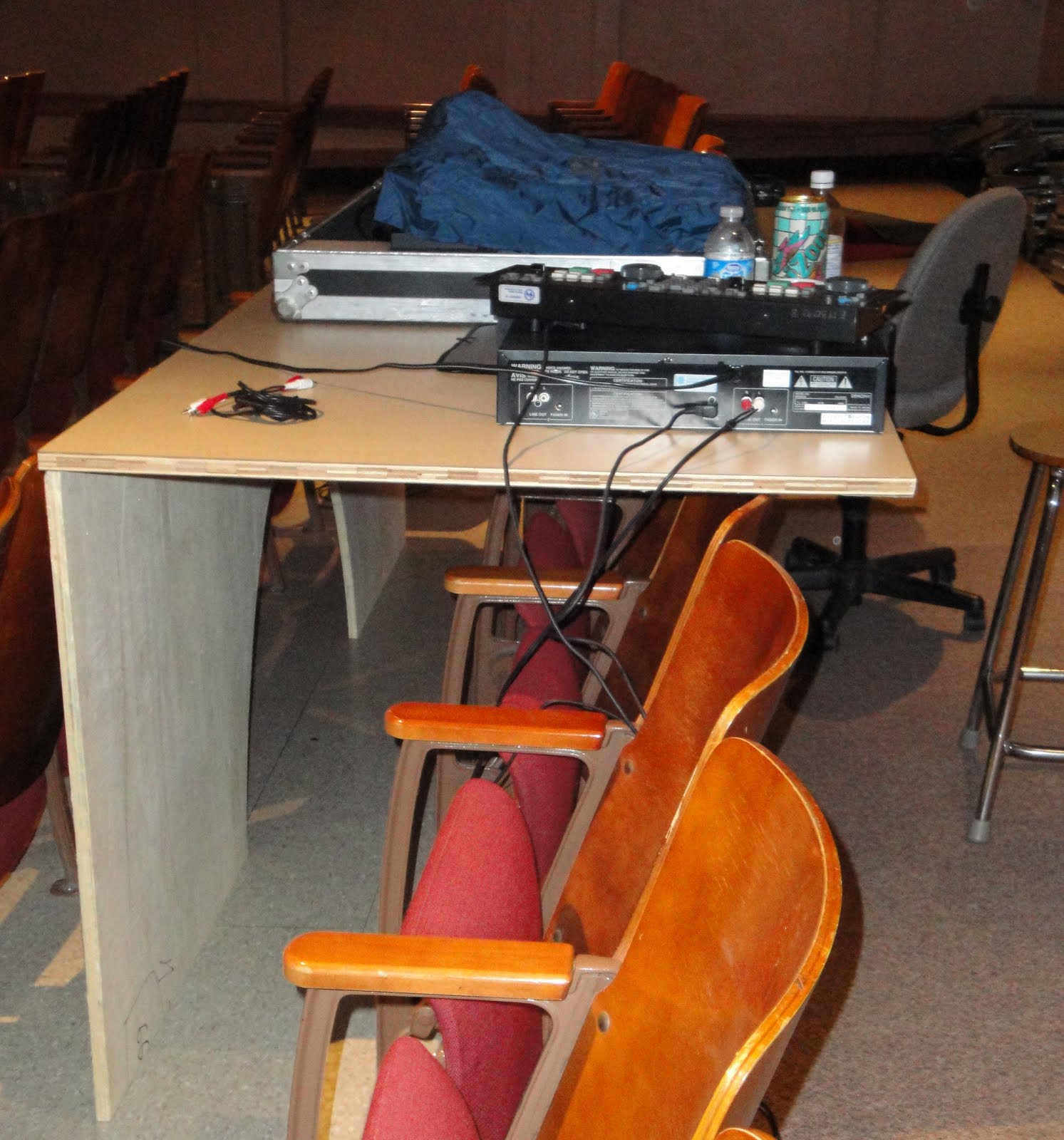
We're going to have to get bands to sell tickets, i.e. give us money upfront in exchange for tickets which they can sell to get their money back or just pitch and call it a donation or fee. We paid to rent an expensive sound board and sound guy - excellent but expensive - and several people don't want to go backwards to low quality sound. But I'd like to stop funding this adventure. Thanks to Mr. St. Cyr for building a cool sound system table to fit over the seats for little money and really fast! We can use it over and over for events like these. And thanks to Mr. Fricke and the tech crew for a perfect evening.
We'll have to relocate the ticket takers and make sure to get student volunteers who will rabidly watch who's coming and going and be willing to stop people from just walking by.
I need to make sure kids are on top of tasks they take on. For the most part, everyone did everything beautifully, but some advertising didn't happen because it was left too late, and teachers weren't being asked to supervise by the kids, they just happened to volunteer. We'll have to explore what stops kids from getting on these jobs - whether it's just general procrastination or is there some anxiety around it.
Showing No Impact Man again cost $100 for the rights, and only two people showed up to see it. Many of my neighbours had said they wanted to see it, but none came. We didn't get much of a turn-out last time either, and when we showed Wall-E last year, only one person came. The only person who watched Ferngully, was my daughter. I'm done with movie nights.
During the evening I had a chance to talk to a few people who have been there for every Earthfest. The first year we did it we threw everything together and hoped for the best, and it was huge. We had about twice as many people as we did this year. What did we do right that year? According to students, it's nothing we did or didn't do. It's the hippie factor. We're losing hippies like flies around here. I still wear long skirts with little jingly bells on the ties - I've got one on right now - but there's pretty much only one token hippie student left in the building. Why are only hippies associated with environmentalism anyway? There are lots of non-folk musicians who are all about the planet. Maybe next year our slogan could be:
Digital Detox Week starts on Monday. Try to go one week without computer, TV, cell phones, iPods, etc. I'm going to try starting tonight, mainly out of necessity. Life is extraordinarily busy right now. Don't forget to come to Earthfest 2010 on Wednesday night!
Twenty-five coal miners died so we could have electricity. If you have ever considered putting some solar panels on your roof, now's the time. In Ontario, feed in tariffs (FITs) will pay for most home systems (under 10 kW).
From the CREW site: A FIT contract pays Ontario generators of solar power $0.80 per kWh of electricity produced, as compared to the $0.07 +/- per kWh of electricity we pay our hydro utility for consumption of electricity, plus delivery and debt service charges = about $0.12 kWh for this community. A 2 kW PV system can generate up to $1700 per year of income and offset about 2 tonnes of greenhouse gas (GHG) emissions.
After all is said and done, with FIT, the prices are guaranteed for 20 years from the time you sign up, and your system will be paid off in about 10 or 12 years regardless of the size. But it's a limited time offer, and judging from the way the home-energy retrofit program was dumped without a word of warning, I'd get in there pretty soon.
Our hydro bills average to about 500 kWh/month which would require a 3.5 kW system (if I did all the many calculations right) which will cost about $35,000, but it's not really feeding the home's energy. It works by feeding the grid. So you still pay regular hydro bills, but you get cash back every month based on the amount of electricity your panels create. Really, just get whatever size of system you can comfortably afford regardless how much power you use. I wish I had read that bit before embarking on all that figuring!
The question is, after the 20 years, after the system is paid for, will the gov. dump the 80 cent payout and keep all that electricity homeowners are generating for free? I wouldn't put it past them. But if lots of us jump on this at least we'll need a lot fewer coal mines. And you can always convert the panels to produce off-grid later.
While you're trying to drive less, think about how you washyourcar. If you wash it on the driveway, all the gunk from the car and whatever soap you might use runs down the driveway and straight into the storm drains which go straight to the rivers which run into the lakes and eventually the oceans. Commercial car washes are actually very environmentally friendly in this respect. But if you really want to wash the car in the comforts of your own home, consider driving onto the lawn or garden. It'll give the yard some much needed watering, and plants, dirt, and rocks are handy for filtering toxins out of water before it hits groundwater levels.
AND keep in mind that biodegradablesoap (anything for that matter) only biodegrades on land, not in the water. Keep soap 200 m away from a body of water when you're camping, and don't let it get into the storm drains! If you wouldn't want to drink it, keep it out of the water. And if you wouldn't dump it in a pristine lake, don't dump it down the storm drains or leave it on the ground to make its way there - ahemcigarettebuttsahem. It's not just about the environment, it's basic common courtesy not to trash what isn't yours.
I was talking with a neighbour about her teenaged daughter's rabid environmentalism. She told me she has to keep reminding her that it's all about balance. Balance. We have to stay balanced...
I didn't say much because she was unaware of my own rabid environmentalism, but I wonder what she meant by balance. Do we need a balance between consumerism and contentment? Do we a balance between wastefulness and reduction? If the environment is on one side of the scale, what's on the other that we might want to incorporate into our lives to even things out for us?
I think what she's saying is that it's too hard to do it all at once, so we need to take it slowly.
Energetic radicals just getting on board don't need to take it slow. They can make huge revolutionary changes overnight for the planet and the adrenaline rush. We don't need no stinking balance! But people who have grown accustomed to and comfortable with long hot showers and sprinklers on the lawn and the garbage just going away every week, and the belief that government won't allow anyone to sell us anything that could harm us, they might need to be awakened more gently.
Okay, if you want just a little change today, when we're only 16 days away from Earthfest 2010, ditch the car whenever you can. And, if it's not too painful, try to re-evaluate when that really is. I think a reasonable distance for almost anyone to walk is 3 km. According to Google Maps, that should take most people about 30 minutes.
Don't have that kind of time? Why not? What's so important in your life that you can't carve out some time to walk back and forth to work? I used to walk 90 minutes to work every day (straight down Weber from Lancaster to Parkside); it was a great time to clear my head and have a bit of thinking space in a hectic life. It's not just for the environment; we would all be much healthier if we walked everywhere. If you tell yourself you have to walk, it gives you permission to take this time for just you. Because your worth it.
You have to carry too much? Get a big backpack or a wagon! That would look cool, and it would keep us all cooler. Or leave the work at home. You probably won't get to it anyway.
If you get sucked into the car again, as I do from time to time now that there's an idle car in my driveway taunting me, forgive yourself and get back on track on the next trip.
This weekend felt smoggy, and it's early April. Forecasters are predicting a warm, dry summer with temperatures to exceed norms by as much as 15-20 degrees. Excuse my acronym*, but WTF?! So instead of highs of 30, are we expected to hit 50? As it gets hotter, we'll see more smog, more bugs and disease, more fires, less food, and surlier tempers.
We can get used to anything. I had a vegetarian friend in university who told me that as she made us spaghetti with hunks of broccoli that kinda looked like meatballs once they were covered in sauce. And I'm reminded of a scalding hot June day when I was leaving the school at the same time as a colleague. As I head towards the bike racks, she commented, "It's way too hot for biking today!" Funny, because I had been just thinking that it was way too hot to get into a sweltering car and hope the A/C gets it to a proper temperature before I get home.
Drive less. Walk and bike more. Make less smog. Save money. Lose weight. Get fit. Think.
And don't panic. We'll get through this if we want to.
______
*Yes, I know it's not precisely an acronym, but nobody says initialism.
A colleague was telling me that during that big Olympic hockey game, water use spiked at every commercial, but was down dramatically during the play. Bathroom breaks. Hey even I watched the end of it, and I generally hate hockey (although I love this local hockey blog). But my question is, if everyone in Canada is just drinking beer and peeing it back out throughout the game, do they really need to flush every time?...
Toilets use a ton of water, and unless you've got a gray water tank or cistern hooked up to your plumbing, it's all treated drinking water that's being dumped. Toilets use 38% of the water used by indoor appliances in the average U.S. home. A low-flow toilet uses 1.6 gal/6 litres per flush. Put another way, that's over 200 ounces of drinking water. If everyone drank 8 8-oz-glasses of water a day as the water bottling industry insists they need to, each toilet flush could have supplied more than three people with water for a day. Each flush.
But there's lot of water, right? The Nestle spokesperson I watched insists we'll always have enough because it's a closed system. We drink, pee, filter, and drink some more. Tell that to Australia. And we're polluting much of our water with sewage and toxins, and it's getting harder and harder to filter it. The less we use now, the more we'll have in future.
At our cabin we use a composting toilet, which works like a dream and uses no water at all. We mix the toilet contents with peat moss, churn it up a bit every few days, and when you go to dump it after it sits in a finishing tray a few weeks, it doesn't look or smell much different than what's on the forest floor already. But it requires some forest to dump in, or a very large backyard.
At home, if you don't want to use as much drinking water, you can get hooked up to a gray water tank or cistern, but that's a lot of work. You can also flush your toilet with rainwater by dumping a bucket of water in the bowl, or keep a bucket in the shower to collect water, but those take effort too. If you really want to save water without any effort at all, just don't flush until it's really necessary. Easy. Unless you've got chronic constipation issues, the toilet will get flushed enough that it doesn't stink up the place. Change your habits briefly if the Queen drops in. Otherwise, would it kill us to be a bit more relaxed about how the inside of our toilets look?
It's interesting to me how information disseminates. Years ago my daughter was doing a project on chocolate in about grade 3, so I told her that a lot of chocolate comes from plantations that use childslavelabour. She told her teacher who refused to listen to such nonsense. Slavery's been over for decades! Even after I sent 30 pages of information from reputable sources, she wouldn't be swayed. A couple of years later, a fewbooks were published on it, it hit the papers, and now it's almost common knowledge. At the very least people aren't as confident taking up the opposition to what is largely accepted as fact: Much of our chocolate, Nestle, Hershey's, M&M/Mars, Cadbury... comes from places that buy or steal children, some as young as ten, who are beaten if they don't work fast enough. Cadbury and Mars have made some chocolate bars fair trade, but don't get those few token bars confused with the majority, which aren't. Look for the fair trade label on each bar. This Easter, if you do the rabbit thing, please buy fair trade chocolate: Cocoa Camino, Divine, Green and Black's...
Now the most recent issue of GQ has an article on cell phones. Finally someone is making problems more public....
Chocolate being slave-produced is a much easier sell now that it's out there. There's a collective knowledge that people seem to absorb. I'm willing to bet nobody will argue about the problems with chocolate production, and I'm hoping a reminder at this time of year will help people make a better choice when buying Easter chocolate. But we love our cell phones! People really don't want to hear anything bad about a product they're absolutely obsessed with. It's the umbilical cord to all social networks. You can't go for a hike in the woods without hearing someone's cell phone go off. But this isn't about how they affect me, but how they affect people who actually own one.
Devra Davis took them on for a few pages of her book The Secret History of the War on Cancer. She found that cell phones are connected to brain cancers. Several poorly conducted studies show no connection by monitoring only light-use clients. Tumors of the auditory nerve are three times more frequent in people who have used cell phones for more than a decade, and always on the side they favour.
The GQ article indicates that doctors are seeing more cases of brain cancer particularly in young professionals, and they think the industry has been discrediting studies showing a risk. Many reports out of Europe link cell phones to brain aging, early-onset Alzheimer's, DNA damage and sperm die-off from the phones being kept in guy's front pockets. According to the International Agency for Research on Cancer, after a decade of cell-phone use, the chance of getting a brain tumor goes up 40%. It gets worse: People who started using a cell phone before the age of 20 - like the entire population of my school - were five times as likely to develop a brain tumor.
I love the article because it gets at human behaviour questions: "...much of the comfort of our modern lives depends on not caring, on refusing to recognize the dangers of microwave radiation." Short term comfort outweighs the potential of tumors many years from now. The article explains the hows and whys in detail. Yes we get radiation from the sun, and it's all around us, but we're exposing ourselves to excessive directed radiation which is harming us.
So what do we do? Unlike the fair trade option for chocolate lovers, there's no radiation-free cell phone option. According to Devra Davis, quoted in the article, "The most important thing you can do is use a speakerphone and an earpiece." Okay, that's not going to happen. It looks too dorky for teenagers to do. It helps that most teens text instead of talking. However, instead of brain problems, this can lead to serious reproductive problems. And nobody's going to wear a lead-lined fanny pack. We can encourage them to keep their phones in their knapsacks furthest from their bodies, and stop hiding it under the desk to text during class! Get them out of their laps! Every inch away from the body reduces the risk dramatically. They need to be taught to text at arm's length.
Another concern raised by all this - one that affect me directly - is wireless signals. We have wireless everything in my house, and I'm going to try, deep breath, to convince my guy to plug back in. The little cord that runs to the wall, or from the mouse to the computer, is not as big a hassle as cancer will be. They also suggest, "If you can't bring yourself to plug back in, at least place the hub far away from your head." Now I just have to figure out what a hub is.
Here's a trailer for a film about one man who had himself prosecuted for buying slave-made chocolate: Tony and the Chocolate Factory
Earthfest 2010 in 24 days! Vote for the best everyday eco-hero film at Earth Day Canada. OneEarth recycled our assembly film for the contest; it's under Waterloo. My short list: Becoming Green (Blyth), Solar Pop Man (Epworth), Tale of Two Peters (Hamilton), Dancing with the Wind (Holland Landing), Portrait of a Composter (Toronto), and Rickshaw Run (Toronto).
George Stroumboulopoulos has a new series call Love, Hate, Propaganda. They had a contest to create propaganda posters or films for current crises. I like Oil at What Cost, Weapons of Mass Destruction, and the videos Air Dry and Plastic Bag Monster. It's unfortunate that the "Read" poster has a spelling mistake.
For some reason that now escapes me we decided to let the 5-year-old stay up for earth hour. She coloured pictures by candlelight and was tucked in a good two hours later than usual. The upside is that she's still in bed now. The downside is I've forgotten how to sleep in. More to the point, I had a booth at the festivities at Kitchener City Hall yesterday...
Most my neighbours didn't turn out their lights last night, and I know a lot of people who roll their eyes at it, "What's one hour going to do?" What it does is remind us that we don't need to live with lights and electronics on all the time. It is possible to turn them off more. At school we did it all day Friday, and it reminds teachers they can teach with the lights off and the kids are actually calmer for it.
The regional event had very low attendance until the end - just as I packed up of course. Maybe if the focus of an evening is from 8:30-9:30, don't start at 4:00 in the afternoon. A 7:00 start would have been more intensive and perhaps more useful. People who did come by my table wanted an Earthfest flier to take away with them. I directed them to the facebook site. It's funny how people seem to take one copy of everything offered, and I can just imagine what they do with it all when they get home. We're going to plaster the city with posters soon enough anyway. We were all filmed for a video that will be on the Living Earth Festival site one of these days.
The best part of the afternoon was talking with the people at the other tables. There were some I knew about, some I learned about, and some I didn't agree with and was looking forward to getting to the bottom of a few issues with. Some people are more receptive to that than others.
The People's Car Co-op was there. I had been part of it at the beginning to do groceries, but I found it easier and cheaper to walk to the grocery store and call a cab to go home, than to book a car, walk to the car pick up area (past the grocery store), drive to the store and home again, drop off the car, and walk back. And it's more expensive than renting a car once you need it for a long distance or long time. It's particularly useful for anyone who needs to run many short errands in one day. KW-Y-Camps has energy-efficient digs with composting toilets. REEP was there, and their zero impact house will be done May 14th. That'll save me the trip to Montreal to see the one built there! And KCI had a few meetings with Reduce the Juice to look into getting solar at the school. It's a bit daunting, and we're not quite ready for it yet.
I got to find out about CREW. That was a great table because the guy heading it actually had geo-thermal and solar at his house, so he could speak from experience about costs and payback. And Merlyn Power and Power Savings Blitz were right next to it. The City of Kitchener table was all about littering, and the City of Waterloo was about energy conservation.
And there was a rapid transit table. The woman there was excellent and answered all my questions even though I'm a nay-sayer. She seemed able to see both sides of the issue well enough to have an intelligent discussion with me. It will essentially replace the iXpress bus, but the LRT will take up a lane, making less room for cars which will dissuade people from driving, and they'll also get rid of free parking in the city. These alone will get people driving less. That the LRT gets a dedicated lane means it will go much faster and solve the problem with congestion in front of the bus.
I suggested doing what they do in someotherareas: make a dedicated lane for buses and cyclists without ripping up the road. Just call the outside lanes of King Street car-free zones (except to move over to park, of course). People will find it harder to drive, the buses will move faster, and more people will bike on the road instead of the sidewalks, and more people will bike in general, AND it will cost NOTHING - well some advertising, and maybe the next term of whomever implements it, but that's it. Once people get used to the system, they'll see the benefits. And then I can cycle with my kids on the street!
Finally, there was a guy selling "Oxo-Biodegradable Poly Bags." I asked what they're made of: poly-ethylene (petroleum), but they're made to biodegrade faster. Okay, but what do you mean by "bio-degrade"? Are they decomposing, or are they just degrading? Do they turn back to their original components found in the earth, like a banana will, or do they just become smaller bits of a processed material?
Crickets.
This is the question I really want explained thoroughly by a chemist who works with the stuff. So far I've asked a chemistry teacher how plastics can be compostable because the big deal about plastic is that once made it can't be unmade. It was created to last forever - which is really useful sometimes, but not with stuff we want to pitch immediately. I was told that there's something added (like corn starch) that composts, leaving tiny bits of plastic behind. But the plastic itself doesn't actually compost; it's just small enough not to be noticed by naked eye. That makes sense to me based on other things I've read, but it doesn't bode well for "compostable" plastic because I don't want microscopic bits of plastic in my garden.
So I asked, can you eat this or grow food in it once it's degraded? "Well," he said, "you can."
"But will it be full of toxins that could be harmful to you - like endocrine disruptors?"
"There's lots of that out there anyway." The implication here is that we have so much crap in our world, hey, what's a little more!
My final question: "Why promote a new kind of plastic bag when you could just carry a cloth bag or basket when you go to the store? Why do we need more new products that will just be thrown out at the end."
"You're not going to carry a basket if you're shopping for clothes, are you?"
"I bring my knapsack to shop for clothes."
"Well, most people don't, so I make bags for clothes stores to use."
So as far as I understand, we'll have bags that degrade faster so we can inhale and ingest the plastic dust faster. We'll see fewer bags stuck in trees, but there will be more toxins stuck in us. On the website it says there's no difference between this and regular plastic until they're exposed to UV light. That's what makes them fall apart. So really they're photo-degradable, which is how other plastics fall apart too, only not as fast. And they're advertised as "tree-less" bags. But they're still disposable! We need to get rid of our single-use mentality. Don't buy or accept anything that will be pitched immediately. It's one really easy thing to do that will have a huge impact on our lives, and it's really really easy thing to change. Well, it seems like a no-brainer to me.
Finally, here's a suggestion if you're running a green event: Give everyone working at a table a travel mug at the beginning as a thank-you for coming. Then they won't all be walking around with disposable cups from the coffee shop next door.
Hey, a guest post!! This is from Dan Grifen from Everything Left:
Spring 2010 is approaching, and there’s a lot of buzz around topics like the economy, taxation, global poverty, restoration in Haiti/Chile, and lastly, green awareness. With spring, Earth Day also draws nearer (April 22nd); as individuals, we must remember and realize the importance of global warming and all of its implications. Subsequent topics discussed as of late include space travel/burning of fossil fuels, deforestation and green building. As nations like Haiti and Chile prepare for rebuilding and new construction, there are many things to consider when advancing. Moving towards cleaner, greener infrastructure is vital in ensuring a successful restoration campaign....
The U.S. Green Building Council is a 501(3)(c) non-profit community of leaders working to make green buildings available to everybody. It’s one of the many organizations playing its role in green progression. Heavy discussion lies on green topics, especially the more recent ones like space travel; others include deforestation, green crops, clothing, energy, and much more. It’s important that we as individuals/citizens stay up-to-date on important global topics like warming. As organizations like the CGI (Clinton Global Initiative), AFH (Architecture for Humanity), and the USGBC (U.S. Green Building Council) conducts sustainability campaigns and enforce strict green constraints, our world will continue to become a better, cleaner place. Machines behind the CGI, Doug Band and Former President Clinton have been pursuing an emission reduction plan in the San Francisco Bay area. Meanwhile, GEC (Globetrotters Engineering Corporation) is underway with green building projects in Chicago, IL. Despite these few national examples, green infrastructure, particularly in places like Haiti, has become an integral part of restoration and construction.
This aligns with the implications of "economic viability" and long term sustainability, posing the questions, "Can Haiti really make it through all the costs of repair and reconstruction?" Infrastructure can take a toll on any economy, especially if the funds aren't there. This goes hand in hand with meeting modern day LEED standards and approaching this in a "greener" sense. Organizations like Architecture for Humanity will make this possible. Architecture for Humanity (1999) is a nonprofit design services firm building "a more sustainable future through the power of professional design." It was formulated through a group of building professionals whose overwhelming passion for construction drove them to provide a way for underdeveloped, suffering countries to rebuild. Through their dedication and hard work, these people will be able to not only create new buildings and infrastructure, but make them bigger, better, and greener.
To touch on just some of the things that AFH covers:
• Alleviating poverty and providing access to water, sanitation, power and essential services
• Bringing safe shelter to communities prone to disaster and displaced populations
• Rebuilding community and creating neutral spaces for dialogue in post-conflict areas
• Mitigating the effects of rapid urbanization in unplanned settlements
• Creating spaces to meet the needs of those with disabilities and other at-risk populations
• Reducing the footprint of the built environment and addressing climate change
As polluters continue to buy their way out of Carbon Cuts globally, and large organizations continue to dump their waste into lakes, ponds and rivers, communities and must play their role in ensuring sustainability. Organizations like the CGI, AFH, and USGBC provide repercussion and policy change for acts such as. Most of the results from warming and climate change are miniscule and unnoticeable now, but our youth and earlier generations will experience firsthand the effects of pollutants and unsustainable efforts. Feel free to visit http://www.earthday.org/ to learn more about what you can do to support your world.
One of our art classes had an assignment to make a poster that would go on a garbage can to tell people what NOT to put there. We have signs on the recycling bins and compost bins, but if people aren't going to them in the first place, they never see those signs. This assortment of posters will be taped to garbage cans around the entire school (thanks to the support of our Principal!). See more below. Regretfully, some of the posters wouldn't upload to blogger; it's amazing the things students came up with! With 27 days to go to Earthfest, put some reminders on the trash cans!
We're down to only 29 days until Earthfest! I haven't been writing or doing much of anything because we all got hit with a flu (on your left). It reinforced the reality that environmentalism takes a back seat when we're rushed or sick or, well, almost anything. Being eco-friendly, like morality in general, is a luxury for good times. For today, try to forge a new eco-habit....
Some things have become habits for me, and that's key. We all turn off lights when we leave a room. Even when I'm scrambling to get out the door, I remember to hit the lights. But it takes time and will to develop those habits. And it's curious to me how that happens and why it doesn't happen for more people. I don't think about composting; it's just second nature and has been for decades. But it's just recently that I got to the point where I stop myself from giving a class handouts that are single sided or not on re-use-it paper if they're only one side long. People at school still forget to turn off computer monitors when they're done, yet that one became ingrained in me easily. I have no idea why. I started putting a travel mug beside my guy's workboots every night for him to use in the morning. He still forgets to grab it.
I realize drive and interest are important factors in developing habits, but I wonder if some people are just more open to change than others. Something like that.
This week, sick as dogs, my 5-year-old tried valiantly to make it to the bathroom, but let loose a torrent of bile on the only carpet we have in the house - the basement stair runner. The runner's hiding the fact that the stairs are seriously sagging, but we're not up for fixing them any time soon. I scrubbed it immediately - baking soda, vinegar, plain soap. That did nothing. Later that night, we tried harsher detergents. Still the entire basement was malevolently fumigated. Our only TV is in the basement and the smell seemed to sink down to ground level, so we couldn't doze in front of the idiot box while we recovered. Could it get any worse? We had to get out the big guns: first a steam cleaner. Nada. Then a chemical assault: Febreze, and later some Odour Destroyer. I'm not sure what's in either, but I pretty much lost my eco cred using them - and maybe a few days of my lifespan. To add injury to insult, after giving up on environmental cleaners and going to the dark side, my efforts again failed. The air refused to clear. We ripped up the carpet and set it out with the trash. It's off to top up the landfill, and we're in the market for a new runner.
Really we don't need a runner, but if we want to present a modicum of, I don't know what, decency? civility? something - we need to cover the tattered steps or risk being shunned by friends and family alike. I typically think nothing's more important than helping the planet recover, but I could be wrong.
I wrote recently that we need constant reminders to keep ourselves on track. I teach courses that focus on social issues, so I'm immersed in this stuff all year. But about mid-July, I start to forget - about fair trade, about slavery, about factory farms. So I got this tattoo. It's Matisse's dancers circling a shifting Pangaea. And it's on my right forearm, clearly visible when I'm about to hand over my Visa card for some unnecessary trifle. It's a reminder that my actions here affect life everywhere else. Tread softly.
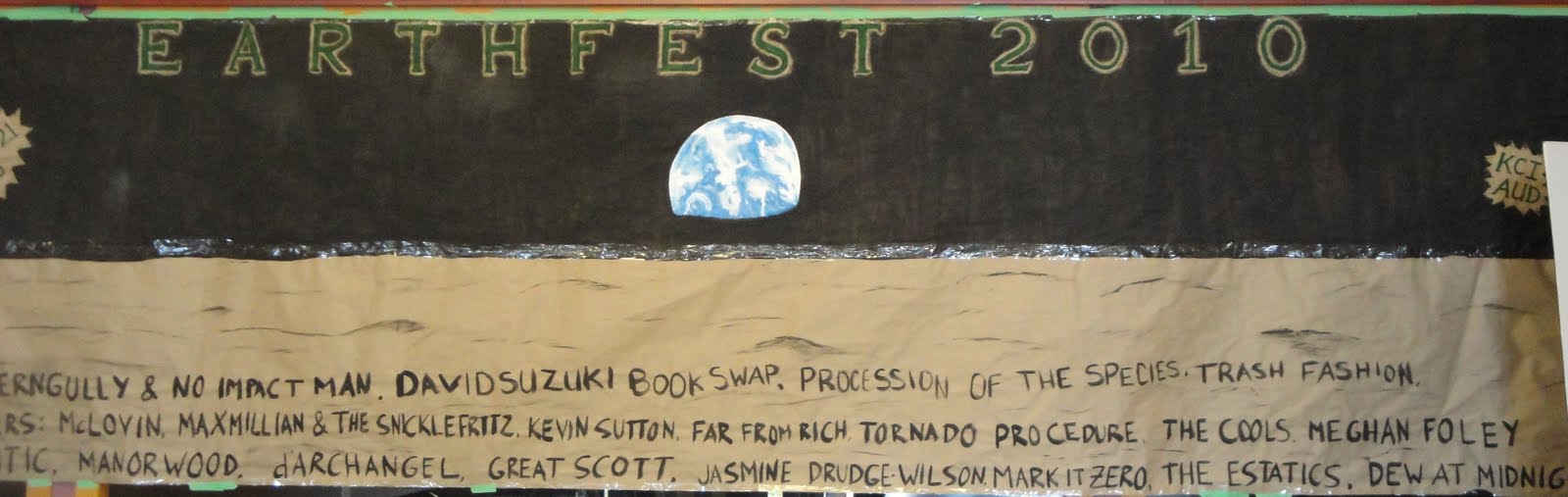
Yesterday I spent some time with fabric paint and some shirts from our school's Free Store. I made a few lunar photo shirts with the earth on a black background and the moon horizon below. I included a few different phrases at the bottom: "We are all part of the same compost heap" by Tyler Durden, "We have met the enemy, and he is us" by Pogo, and "Before it's too late" - the title of the collective song/letter we put together for Stephen Harper. I did a bunch of them because the visual is the focus of this year's Earthfest (35 days left!) - the 40th anniversary of the first Earth Day, which was inspired by none other than photos of the earth from space take a year before. See more designs below....
This one says "Plastic never dies - but we do." Last year I sold quite a few dead-fish-surrounded-by-water-bottles t-shirts. Macabre bunch. The lunar photo shirts take about an hour each - hand painted with fabric paints. This one is magic marker and took under five minutes. And I bet more people will want it.
I like the frog in this one. I did another one like it, but the frog was a bit of a mutant. It says "It's not easy being green. Plastic kills." There's a bit of a theme going on here. This one took about 20 minutes to get the frog all stripey and splashy.
This was another quick one - it's simple and some people will go for that. It just has Earthfest 2010 in the bottom corner. The vine was easy to paint. On a light-coloured shirt, I could do it even faster with markers. Let me know which you like or if you have any other ideas. Want to make some shirts with us at KCI? Come to room 271 at 2:35, on Thursday, March 25th. You really don't need to know how to paint. Check out those dead fish again!