I was pondering why kids need to be connecting to their phones and facebook and MSN constantly. And further, why is anyone willing to have their lives spread open for public viewing on reality TV shows. It seems antithetical to the privacy we all crave.
But maybe that's the problem. For many centuries in the urban west people have lived publicly. They had tiny places to live, often many slept in one room, but the marketplace was the place to be. People had all the dirt on one-another first hand. Maybe our drive to expose ourselves on-line or on TV is our technologically-enhanced way of joining the marketplace. Perhaps we're forcing ourselves to live privately, decently, when it's actually against our true nature...
Just a thought. In other news, Scientific American has a meaty issue out right now. A list of 10 human creations the world would be better off without includes teflon, landfills, bunker fuel, and bisphenol A.
Another article chronicles the limits to specific resources. Oils peaking, so it'll still be around for years, but harder and harder to access. In 2025, they're predicting we'll be fighting over water. We're losing our fish to poor management. And our species extinction rate in the last hundred years is similar to that of the Permian-Triassic Extinction or great death of many moons ago. That one was caused, some think, by excess carbon dioxide in the atmosphere causing hypercapnia. And 30% of amphibians - an indicator species of the health of an eco-system - are endangered right now.
Finally, they lay odds on how we'll all die off. It's a cheery magazine! Runaway global warming and a killer pandemic are the top two possibilities A solar superstorm and a nuclear war are next up. Asteroids hitting the earth? That's a long shot. I would have expected mass starvation and dehydration to be on the list, but it wasn't even mentioned.
below the fold
Monday, September 27, 2010


Sunday, September 26, 2010
Again with the Wireless Worry
Yesterday's Globe & Mail had an article with excerpts from the book Disconnect by Devra Davis, an epidemiologist. It's not really that big a deal to stop carrying your phone in your pocket, or text instead of holding it to your head, is it?
Here's some bits that continue to worry me despite the science that suggests it really can't hurt us...
"...people who have used cellphones for half an hour a day for more than a decade have about twice the risk of glioma, a rare kind of brain tumour, on the side of the head where they hold the phone."
"...microwaves, known as non-ionizing radiation, were long thought to be benign because they weren't strong enough to bump electrons from atoms....[but] rats exposed to just two hours of microwave radiation had broken strands of DNA, the damage known to occur in cancer. The rats also had brain-cell alterations, memory lapses and fluids leaking from their brains into their blood..."
"According to the fine print of the safety and product information brochure accompanying every cellphone, pressing the phone to your ear is a no-no..." Blackberry specifies that people should "keep the BlackBerry device at least 0.98 in. (25 mm) from your body (including the abdomen of pregnant women and the lower abdomen of teenagers) when the BlackBerry device is turned on and connected to the wireless network."
"The fact that ready money has been there to support those who cast doubt on the dangers of radio-frequency radiation certainly plays some role in the perpetuation of their views, as it did with tobacco, asbestos, benzene, and hormone-replacement therapy."
"The need for research should not be allowed to become an excuse to carry on as though everything is fine, until we have incontrovertible proof that it is not."
below the fold
Here's some bits that continue to worry me despite the science that suggests it really can't hurt us...
"...people who have used cellphones for half an hour a day for more than a decade have about twice the risk of glioma, a rare kind of brain tumour, on the side of the head where they hold the phone."
"...microwaves, known as non-ionizing radiation, were long thought to be benign because they weren't strong enough to bump electrons from atoms....[but] rats exposed to just two hours of microwave radiation had broken strands of DNA, the damage known to occur in cancer. The rats also had brain-cell alterations, memory lapses and fluids leaking from their brains into their blood..."
"According to the fine print of the safety and product information brochure accompanying every cellphone, pressing the phone to your ear is a no-no..." Blackberry specifies that people should "keep the BlackBerry device at least 0.98 in. (25 mm) from your body (including the abdomen of pregnant women and the lower abdomen of teenagers) when the BlackBerry device is turned on and connected to the wireless network."
"The fact that ready money has been there to support those who cast doubt on the dangers of radio-frequency radiation certainly plays some role in the perpetuation of their views, as it did with tobacco, asbestos, benzene, and hormone-replacement therapy."
"The need for research should not be allowed to become an excuse to carry on as though everything is fine, until we have incontrovertible proof that it is not."
below the fold
Saturday, September 25, 2010
Facebook in the Schools
We have facebook access in our school now. I've not been writing as much about what our school is doing because I'm putting much of it on our facebook page instead. I'll still post what we're doing here and there for anyone else to use in their schools.
After I made the page for our club, I realized I should have done it under a new, non-personal facebook moniker. So I made a teacher facebook page for myself and made my new, teacherly facebook page the admin. Unfortunately, it wouldn't accept Ms. as a first name (nor Ms), so I have two Marie Snyder pages, using two different e-mails, to keep straight.
But the point is, we now have facebook in the schools, but we haven't been told much about how we should be using it - the legalities of interfacing with students on-line. There will be an assembly coming up, but not soon enough. I'm taking a chance doing this, but it's just such a convenient way to stay in touch and provide information with students. I went on facebook in the first place because the first Earthfest was being organized, and students were doing tons of talking and organizing outside of club meetings on a facebook page. I joined just to keep track of what was going on - make sure things were getting done, and help sort out any problems if needed.
At our last meeting, it was really handy to use a computer with a projector, open the facebook page, and type the minutes while kids shared ideas. Then everyone could see what was going on, and people coming in late could immediately see what they missed. Anyone who missed the meeting, can get all the info from home. It's clearly a useful tool for extracurricular events. I could also see it possibly being used for notes in class, except then why would anyone come to class if they could get all the notes on-line?
Using a computer lab with accessible facebook is a different story. They don't much try playing games anymore, but they're all on their facebook page as they work - fipping back and forth. One student just the other day complained, people keep messaging me, so I have to respond or they'll get mad at me. I explained, just click it off and they'll think you're just not getting their message yet. Don't let them know you're on a computer, so you can get all your work done during class time. The people messaging her were all in different labs throughout the school, so it's clearly not an isolated problem.
Phones allowed in classes? Please let's not go there.
below the fold
After I made the page for our club, I realized I should have done it under a new, non-personal facebook moniker. So I made a teacher facebook page for myself and made my new, teacherly facebook page the admin. Unfortunately, it wouldn't accept Ms. as a first name (nor Ms), so I have two Marie Snyder pages, using two different e-mails, to keep straight.
But the point is, we now have facebook in the schools, but we haven't been told much about how we should be using it - the legalities of interfacing with students on-line. There will be an assembly coming up, but not soon enough. I'm taking a chance doing this, but it's just such a convenient way to stay in touch and provide information with students. I went on facebook in the first place because the first Earthfest was being organized, and students were doing tons of talking and organizing outside of club meetings on a facebook page. I joined just to keep track of what was going on - make sure things were getting done, and help sort out any problems if needed.
At our last meeting, it was really handy to use a computer with a projector, open the facebook page, and type the minutes while kids shared ideas. Then everyone could see what was going on, and people coming in late could immediately see what they missed. Anyone who missed the meeting, can get all the info from home. It's clearly a useful tool for extracurricular events. I could also see it possibly being used for notes in class, except then why would anyone come to class if they could get all the notes on-line?
Using a computer lab with accessible facebook is a different story. They don't much try playing games anymore, but they're all on their facebook page as they work - fipping back and forth. One student just the other day complained, people keep messaging me, so I have to respond or they'll get mad at me. I explained, just click it off and they'll think you're just not getting their message yet. Don't let them know you're on a computer, so you can get all your work done during class time. The people messaging her were all in different labs throughout the school, so it's clearly not an isolated problem.
Phones allowed in classes? Please let's not go there.
below the fold
Tuesday, September 21, 2010
Brainstorming
Today our club met for the first time, and there was a plethora of ideas from people old and new:
A KCI movie night - or Waterloo Region student movie night?? - at one of these movies: Force of Nature: The David Suzuki Movie (playing October 15-21 at the original Princess Cinema), or Waterlife (playing October 21st at the Princess Twin). I'm leaning towards the former since some classes will be going to the latter, maybe Friday the 15th at 9:00??
We also brainstormed ideas for raising money. We could have teachers compete with students or against one another to do Sudokus on projectors (facing away from each other). People could put money in a bucket next to the competitor they're hoping will win. We can't bet proper (i.e. distribute winnings), but they might enjoy knowing they bet on a winner. The competitor who wins gets to choose the charity.
We could have a sing-off. Students could sing on the steps to the aud at lunch, and students vote for the best one by putting money in their bucket. Again, the winner can choose the charity it all goes to.
I suggested a Scrabble competition between students and English teachers. Students could pay a quarter for every word they make - and take turns (tap in/out) battling a teacher. Nobody jumped on that one.
To promote the Free Store, we'll advertise the clothes as "vintage" or "retro" instead of "used." And we'll have a Clean Out Your Closet Day - maybe over Thanksgiving weekend.
To get more people to compost, we'll roll the buckets through the hallways en masse with bells and whistle and pom-poms during a lunch this week to raise awareness of the new green bins* and what goes in them. We're going to check if we can get lids for the garbage cans. One problem with the green bins is that they have a lid, and kids might not want to have to open it with one hand if their hands are full of stuff - so they'll just dump everything into an open garbage can. Also there's only three bins in the school and tons of garbage cans, so it's still a lot easier to toss stuff than recycle or compost.
For our food drive, we'll get students from each grade to make a sculpture of the cans collected in the front hall to compete for the best grade can design.
I'm hoping to send some students to the AIDS Awareness Conference on the morning of October 27th.
Any other ideas??
___
* I'm still not sold on the green bin idea - we're losing our compost for our gardens - but it would be too much to ask, I think, for students to separate garbage further into compost, green bin, recycling, and waste. Not yet, anyway.
below the fold
A KCI movie night - or Waterloo Region student movie night?? - at one of these movies: Force of Nature: The David Suzuki Movie (playing October 15-21 at the original Princess Cinema), or Waterlife (playing October 21st at the Princess Twin). I'm leaning towards the former since some classes will be going to the latter, maybe Friday the 15th at 9:00??
We also brainstormed ideas for raising money. We could have teachers compete with students or against one another to do Sudokus on projectors (facing away from each other). People could put money in a bucket next to the competitor they're hoping will win. We can't bet proper (i.e. distribute winnings), but they might enjoy knowing they bet on a winner. The competitor who wins gets to choose the charity.
We could have a sing-off. Students could sing on the steps to the aud at lunch, and students vote for the best one by putting money in their bucket. Again, the winner can choose the charity it all goes to.
I suggested a Scrabble competition between students and English teachers. Students could pay a quarter for every word they make - and take turns (tap in/out) battling a teacher. Nobody jumped on that one.
To promote the Free Store, we'll advertise the clothes as "vintage" or "retro" instead of "used." And we'll have a Clean Out Your Closet Day - maybe over Thanksgiving weekend.
To get more people to compost, we'll roll the buckets through the hallways en masse with bells and whistle and pom-poms during a lunch this week to raise awareness of the new green bins* and what goes in them. We're going to check if we can get lids for the garbage cans. One problem with the green bins is that they have a lid, and kids might not want to have to open it with one hand if their hands are full of stuff - so they'll just dump everything into an open garbage can. Also there's only three bins in the school and tons of garbage cans, so it's still a lot easier to toss stuff than recycle or compost.
For our food drive, we'll get students from each grade to make a sculpture of the cans collected in the front hall to compete for the best grade can design.
I'm hoping to send some students to the AIDS Awareness Conference on the morning of October 27th.
Any other ideas??
___
* I'm still not sold on the green bin idea - we're losing our compost for our gardens - but it would be too much to ask, I think, for students to separate garbage further into compost, green bin, recycling, and waste. Not yet, anyway.
below the fold
Monday, September 20, 2010
Upcoming Events
There are a few things coming up you might be interested in...
 Bill 28 has been introduced to enable Ontario police to fine people who drop cigarette butts - the number one litter item. Maximum fines proposed? $3,000! It could be over a year before anything happens with it, but this is the window for people to get involved and tell their local MPP what they think. We're getting some great butt bins at school to be prepared for the potential law (and to keep the butt litter down in general). I tried to google "butt buckets" at school, but it kept blocking me, apparently from seeing porn sites.
Dare to Remember - Stephen Lewis's group is challenging people to raise money for AIDS by daring one another to do things... like marathon juggling, or a Scrabble tournament, or on-going musicians playing in tandem. There are lots of ideas on the website. The challenge due date is December 1st, International AIDS Awareness DAy.
Earth Day Canada has a contest out now for the best bit of environmental activism. Send in entries by November 15th.
World Wildlife Fund has some grant money available for student projects. Apply by October 7th.
Safe Drinking Water Foundation has free educational materials anyone can use. They'll give you the tools to monitor your schools water footprint.
The IPCC wants help to plant one million trees in 2010. You can help.
below the fold

Dare to Remember - Stephen Lewis's group is challenging people to raise money for AIDS by daring one another to do things... like marathon juggling, or a Scrabble tournament, or on-going musicians playing in tandem. There are lots of ideas on the website. The challenge due date is December 1st, International AIDS Awareness DAy.
Earth Day Canada has a contest out now for the best bit of environmental activism. Send in entries by November 15th.
World Wildlife Fund has some grant money available for student projects. Apply by October 7th.
Safe Drinking Water Foundation has free educational materials anyone can use. They'll give you the tools to monitor your schools water footprint.
The IPCC wants help to plant one million trees in 2010. You can help.
below the fold
Sunday, September 19, 2010
Another Look at LRT
I'm still surprised by how many people I know who want light-rail transit in the city. I'm not yet convinced. And after talking to Jan d'Ailly on my front porch yesterday, I'm all the more solidly opposed. He told me that the LRT will actually be slower, from end to end, than the iExpress bus by 2 minutes. So, it's expensive, it'll make a mess, it still won't connect to anyone who lives or works far from the core, and it's slower.
Many people I know who love the idea seem to follow this line by John Shortreed who suggests, "LRT in the last 20 years has become a fashion statement." They think most people don't flock to buses because of a stigma, because they're yucky. But they will suddenly ditch their cars for shiny new LRT. I'm not convinced this attitude represents the majority of Waterloo Region citizens. Well, mainly because I take the bus from time to time, and that attitude sort of implies that it's kind of a loser thing to do to sink so low as to take a bus. Funny, I don't feel like a loser taking the bus. And other people on the bus don't seem so bad either. And that's a pretty costly trend we're jumping on.
Shortreed's concern with LRT is that there's just not enough downtown employment to justify the LRT. That's been my point all along. Who's going to drive from Beechwood to the LRT station, take the transit to the other end (North-South only) of town, then need a cab or bus to get to work from the station there. People in this city don't primarily live and work in the core, and there isn't room at the core to re-build enough to entirely change that fact. Some people are concerned that this city will be huge soon, and how will we move all those people. But most of those people will still be too far from the core to make LRT their primary transportation. It's a wide city that needs an interconnected series of buses that all run smoothly together. We need to raise the status of buses, make them work better, not write them off.
If the goal is to get rid of cars, then we have to make the city less car-friendy. It costs nothing to make a dedicated lane on the outside lanes of King Street so only buses and bikes can drive there. It will make driving down King Street a pain, but that's the whole idea. The iExpress will be even faster, and biking will be safer. And if we really want to act like a big city, we need to ditch the free parking mentality of our region. Everyone expects to park for free on the streets and in the malls. We don't want to hurt the small businesses near the core, however, so we have to make sure the parking costs are the same or more at the big malls. If it cost me $10 to park at Conestoga Mall, then taking my kids on the bus or on bikes suddenly looks like a much better idea.
Unfortunately, I don't think decreasing car use is the actual goal however. There was an article in yesterday's Record that suggests the whole point of the LRT has little to do with moving people; it's all about attracting more people, to "build an urban form." We all want growth, right? But we can't keep growing linearly in a finite system with limits to our resources - no matter how many jobs will be created, it's not a system that can keep working. We need to give up the growth model we've all been enamoured with for the past few centuries and develop a usable sustainable model that keeps population stable instead of ever-increasing, and allows for good living conditions for all instead of always hoping for new and better stuff.
End of rant.
below the fold
Many people I know who love the idea seem to follow this line by John Shortreed who suggests, "LRT in the last 20 years has become a fashion statement." They think most people don't flock to buses because of a stigma, because they're yucky. But they will suddenly ditch their cars for shiny new LRT. I'm not convinced this attitude represents the majority of Waterloo Region citizens. Well, mainly because I take the bus from time to time, and that attitude sort of implies that it's kind of a loser thing to do to sink so low as to take a bus. Funny, I don't feel like a loser taking the bus. And other people on the bus don't seem so bad either. And that's a pretty costly trend we're jumping on.
Shortreed's concern with LRT is that there's just not enough downtown employment to justify the LRT. That's been my point all along. Who's going to drive from Beechwood to the LRT station, take the transit to the other end (North-South only) of town, then need a cab or bus to get to work from the station there. People in this city don't primarily live and work in the core, and there isn't room at the core to re-build enough to entirely change that fact. Some people are concerned that this city will be huge soon, and how will we move all those people. But most of those people will still be too far from the core to make LRT their primary transportation. It's a wide city that needs an interconnected series of buses that all run smoothly together. We need to raise the status of buses, make them work better, not write them off.
Environmentally, old is almost always better than new. Sticking with an old gas lawnmower with many years of life in it uses fewer resources in the grand scheme of things than landfilling it for a new electric one. You could, however, sell it to someone in need in favour of a push mower. That would be even better. The LRT demands huge resources to build, that I don't expect will be offset by the tiny bit saved every year by a more efficient engine.
Unfortunately, I don't think decreasing car use is the actual goal however. There was an article in yesterday's Record that suggests the whole point of the LRT has little to do with moving people; it's all about attracting more people, to "build an urban form." We all want growth, right? But we can't keep growing linearly in a finite system with limits to our resources - no matter how many jobs will be created, it's not a system that can keep working. We need to give up the growth model we've all been enamoured with for the past few centuries and develop a usable sustainable model that keeps population stable instead of ever-increasing, and allows for good living conditions for all instead of always hoping for new and better stuff.
End of rant.
below the fold
Grade School Free Store Idea
We're getting our free store up and running, and, at the same time I just cleaned out my 6-year-old's closets to send to Goodwill. Last Wednesday was meet the teacher night. Imagine if there was a room at the school where parents could drop off old clothes and root through for new-to-me clothes. It could just be tables in the gym with size 2, 3, 4... above each table. Parents could drop off at the beginning of the evening under the right size, and sort through later on for new stuff.
It could be easily monitored by a few grade 6 kids. And if people felt guilty for taking more than they left, there could be a donation jar as well - cash going to the school or as a charity drive. At the end of the night, you'd just need someone with a van to cart all the clothes somewhere - or you could arrange in advance to have them picked up by one of the charities that takes clothes. It could be an event that happens at meet the teacher in the fall and again during any earth day celebrations in spring. Maybe Christmas have a re-gifting area somewhere in the school during whatever concert or pageant you put on.
It keeps consumerism down and helps shrink the rich/poor divide when we all help each other.
below the fold
It could be easily monitored by a few grade 6 kids. And if people felt guilty for taking more than they left, there could be a donation jar as well - cash going to the school or as a charity drive. At the end of the night, you'd just need someone with a van to cart all the clothes somewhere - or you could arrange in advance to have them picked up by one of the charities that takes clothes. It could be an event that happens at meet the teacher in the fall and again during any earth day celebrations in spring. Maybe Christmas have a re-gifting area somewhere in the school during whatever concert or pageant you put on.
It keeps consumerism down and helps shrink the rich/poor divide when we all help each other.
below the fold
Saturday, September 18, 2010
Cool Video from Grist
There are a couple of great videos at grist.org. I especially like this one that links to a study done that show that women on bikes are a good indicator of a healthy city. Interesting, eh?
Women In Motion: New Lady Riders Reflect on NYC Cycling from Streetfilms on Vimeo.
There's another on the miniature earth: what would we look like if there were 100 representative people on earth. That almost half the world doesn't have clean water is the one that gets to me the most.
And an excellent analysis of a car commercial in which a polar bear hugs the driver of an electric car. I'm linking the whole article in hope people read the analysis.
Now turn off your computer and go outside!
below the fold
Women In Motion: New Lady Riders Reflect on NYC Cycling from Streetfilms on Vimeo.
There's another on the miniature earth: what would we look like if there were 100 representative people on earth. That almost half the world doesn't have clean water is the one that gets to me the most.
And an excellent analysis of a car commercial in which a polar bear hugs the driver of an electric car. I'm linking the whole article in hope people read the analysis.
Now turn off your computer and go outside!
below the fold
Sunday, September 12, 2010
Wireless Controversy Rebuttal
A former student tried to comment on a previous post, but the comment was blocked apparently because it was too long. I'll put it here instead:
Hi Marie, Devin here with the comment I promised. This will get pretty sciencey, and I'm glossing over some parts in a hand-wavey manner simply because there's too much material to cover. If you have any questions please don't hesitate to ask, this is something which would be easier to explain in person and it's no trouble for me.
To understand why I don't think cellphones and WiFi are harmful you need to understand electromagnetic waves. But first you need to understand a bit about waves in general.
All waves have two basic properties (that we're concerned with), wavelength and frequency. There's a nice image that explains what wavelength is here. It is the distance it takes for a given wave to complete one full cycle. This has a standard unit of meters.
Frequency is the number of cycles the wave can complete per second. This is measured in Hertz (which is the same unit as 1/seconds).
The velocity of a wave is given by the equation: v=λf. Where v is the velocity, λ (Greek letter lowercase lamda) is the wavelength, and f is the frequency.
Looking at the equation this should be fairly intuitive. Think of the classic v=d/t (velocity is distance per unit time). Our wave equation above is identical, we have wavelength (distance) times frequency (1/time).
Now the neat thing about electromagnetic waves is that they always travel at the speed of light, c. So the equation above becomes c=λf.
From this equation you can see that if you increase the wavelength, the frequency must decrease (since otherwise their product would no longer equal c). The opposite is also true.
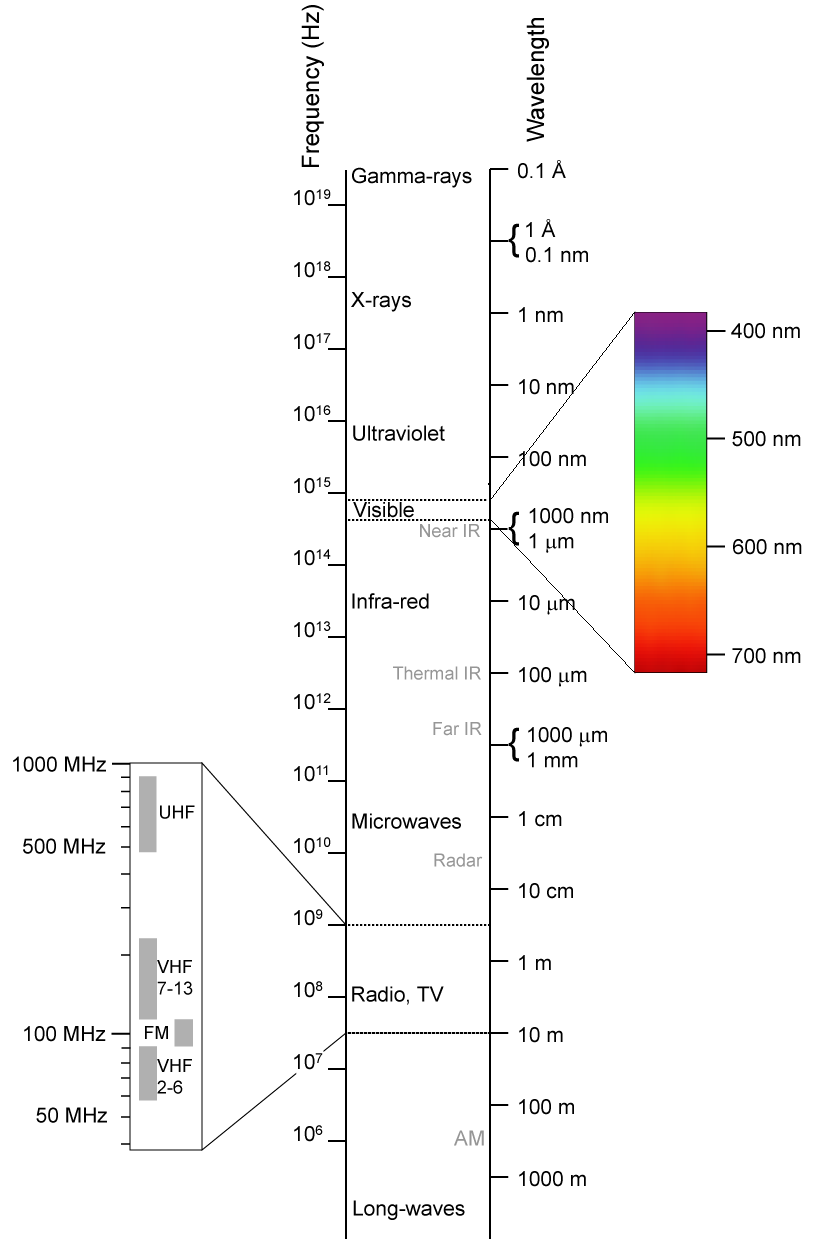
Now we can talk about the electromagnetic spectrum found here. As you can see, on the left there is decreasing frequency as you progress down the chart, and an increasing wavelength on the right.
Note the positions of radio waves and microwaves relative to visible light and ultraviolet (sunlight). Radio waves have a very low frequency compared to visible light (seven orders of magnitude lower).
The energy carried by any electromagnetic wave is given by the equation E=hf, where E is the energy, h is Plank's constant and f is the frequency. Plank's constant is just a number (a very small number), for the sake of this example we can pretend it's one so that it is clear that the energy is directly proportional to the frequency.
Clearly then, if radio waves carry 10^8 Joules of energy, visible light carries 10^15! Radios obviously operate in the radio wave range, cellphones and WiFi operates in the microwave range. This is still 4 orders of magnitude lower than visible light.
If you take nothing else away from this understand this part: The light coming out of your lightbulb is bombarding you with significantly more powerful radiation than anything your cellphone or WiFi router could ever push out.
Of course once you breach a certain energy level this radiation becomes what is called "ionizing radiation", and that's why you wear sunscreen for ultraviolet light or lead vests for X-rays.
Again, this is a lot to understand and I'm breezing through several hundred years worth of scientific discoveries in a few paragraphs, so if you have any questions please let me know and I'll do my best to clarify.
Devin
Okay - here are some question:
1. How do we explain incidents such as the increase in headaches, blurred vision, etc. in a group of people once a system was turned on, and their symptoms disappeared as soon as it was turned off - and they had no knowledge of the new transmitter? Coincidence? Or the fact that tumours of the auditory nerve are three times more frequent in people who have used cell phones for more than a decade, and always on the side they favour as was reported by Dr. Devra Davis in The Secret History of the War on Cancer. I know they're only showing a correlation and not causation necessarily, but it still gives one pause.
2. If we held lightbulbs up to our head for many hours a day, would we likely increase our chances of getting tumours? That is, does the fact that we have very close contact with these devices affect the chance of the microwaves affecting us even if the radiation is extremely low?
3. And, this might be a stupid question, but if microwaves are not at all harmful to us, how is it that they can be used to cook meat? I mean, I've made little cakes with a lightbulb in an Easy Bake Oven, but I don't think the lightbulb could cook a piece of steak as efficiently as a microwave oven. I suspect the microwaves are used differently in that application than in phones and such; is that the case? As far as I understand it, microwaves cook food by making molecules vibrate. Why isn't it possible for phones to have the same effect?
below the fold
Hi Marie, Devin here with the comment I promised. This will get pretty sciencey, and I'm glossing over some parts in a hand-wavey manner simply because there's too much material to cover. If you have any questions please don't hesitate to ask, this is something which would be easier to explain in person and it's no trouble for me.
To understand why I don't think cellphones and WiFi are harmful you need to understand electromagnetic waves. But first you need to understand a bit about waves in general.
All waves have two basic properties (that we're concerned with), wavelength and frequency. There's a nice image that explains what wavelength is here. It is the distance it takes for a given wave to complete one full cycle. This has a standard unit of meters.
Frequency is the number of cycles the wave can complete per second. This is measured in Hertz (which is the same unit as 1/seconds).
The velocity of a wave is given by the equation: v=λf. Where v is the velocity, λ (Greek letter lowercase lamda) is the wavelength, and f is the frequency.
Looking at the equation this should be fairly intuitive. Think of the classic v=d/t (velocity is distance per unit time). Our wave equation above is identical, we have wavelength (distance) times frequency (1/time).
Now the neat thing about electromagnetic waves is that they always travel at the speed of light, c. So the equation above becomes c=λf.
From this equation you can see that if you increase the wavelength, the frequency must decrease (since otherwise their product would no longer equal c). The opposite is also true.
Now we can talk about the electromagnetic spectrum found here. As you can see, on the left there is decreasing frequency as you progress down the chart, and an increasing wavelength on the right.
Note the positions of radio waves and microwaves relative to visible light and ultraviolet (sunlight). Radio waves have a very low frequency compared to visible light (seven orders of magnitude lower).
The energy carried by any electromagnetic wave is given by the equation E=hf, where E is the energy, h is Plank's constant and f is the frequency. Plank's constant is just a number (a very small number), for the sake of this example we can pretend it's one so that it is clear that the energy is directly proportional to the frequency.
Clearly then, if radio waves carry 10^8 Joules of energy, visible light carries 10^15! Radios obviously operate in the radio wave range, cellphones and WiFi operates in the microwave range. This is still 4 orders of magnitude lower than visible light.
If you take nothing else away from this understand this part: The light coming out of your lightbulb is bombarding you with significantly more powerful radiation than anything your cellphone or WiFi router could ever push out.
Of course once you breach a certain energy level this radiation becomes what is called "ionizing radiation", and that's why you wear sunscreen for ultraviolet light or lead vests for X-rays.
Again, this is a lot to understand and I'm breezing through several hundred years worth of scientific discoveries in a few paragraphs, so if you have any questions please let me know and I'll do my best to clarify.
Devin
Okay - here are some question:
1. How do we explain incidents such as the increase in headaches, blurred vision, etc. in a group of people once a system was turned on, and their symptoms disappeared as soon as it was turned off - and they had no knowledge of the new transmitter? Coincidence? Or the fact that tumours of the auditory nerve are three times more frequent in people who have used cell phones for more than a decade, and always on the side they favour as was reported by Dr. Devra Davis in The Secret History of the War on Cancer. I know they're only showing a correlation and not causation necessarily, but it still gives one pause.
2. If we held lightbulbs up to our head for many hours a day, would we likely increase our chances of getting tumours? That is, does the fact that we have very close contact with these devices affect the chance of the microwaves affecting us even if the radiation is extremely low?
3. And, this might be a stupid question, but if microwaves are not at all harmful to us, how is it that they can be used to cook meat? I mean, I've made little cakes with a lightbulb in an Easy Bake Oven, but I don't think the lightbulb could cook a piece of steak as efficiently as a microwave oven. I suspect the microwaves are used differently in that application than in phones and such; is that the case? As far as I understand it, microwaves cook food by making molecules vibrate. Why isn't it possible for phones to have the same effect?
below the fold
Wednesday, August 18, 2010
Wireless Controversy

I suggest, again, that interested readers peruse this GQ article on the topic. From the GQ article:
Wi-Fi operates typically at a frequency of 2.4 gigahertz (the same frequency as microwave ovens) but is embedded with a wider range of modulations than cell phones, because we need it to carry more data. "It never ceases to surprise me that people will fight a cell tower going up in their neighborhoods," Blake Levitt, author of Electromagnetic Fields: A Consumer's Guide to the Issues and How to Protect Ourselves, told me. "They they'll install a Wi-Fi system in their homes. That's like inviting a cell tower indoors."
In the summer of 2006, a super-Wi-Fi system known as WiMAX was tested in rural Sweden. Bombarded with signals, the residents of the village of Götene—who had no knowledge that the transmitter had come online—were overcome by headaches, difficulty breathing, and blurred vision, according to a Swedish news report. Two residents reported to the hospital with heart arrhythmias, similar to those that, more than thirty years ago, Allen Frey induced in frog hearts. This happened only hours after the system was turned on, and as soon as it was powered down, the symptoms disappeared.
The concern about Wi-Fi is being taken seriously in Europe. In April 2008, the national library of France, citing possible "genotoxic effects," announced it would shut down its Wi-Fi system, and the staff of the storied Library of Sainte-Geneviève in Paris followed up with a petition demanding the disconnection of Wi-Fi antennas and their replacement by wired connections. Several European governments are already moving to prohibit Wi-Fi in government buildings and on campuses, and the Austrian Medical Association is lobbying for a ban of all Wi-Fi systems in schools, citing the danger to children's thinner skulls and developing nervous systems.
...
Our school is introducing Wi-Fi in some areas of the school this fall, along with student e-mails and access to facebook. I'd like to be able to show YouTube clips in class, but they're still firewalled. But I'm not convinced adding more technology to teaching necessarily makes for a better learning environment - or a healthy one.
below the fold
Thursday, July 8, 2010
Negligent Blogger
It's been almost a month since I wrote anything environmentally-minded. It's not that I'm not thinking about it; just too busy to act. Protesting in Toronto? Regretfully, no. Prepping in advance for the first day of school? Nope. Weeding my gardens? Close... I spent my limited time on this earth watching every single episode of Weeds - all five seasons. I can't believe he killed her with a croquet mallet! Will he get caught? Will the marriage survive? How many men will happily watch Fried Green Tomatoes with their wives now? Did Mary-Louise Parker find a time portal?
These hot sticky days always remind me of seeing Stephen Lewis speak about his time in Africa, and his disappointment at Canadians with air conditioners. Most people in Africa make it through the hottest temperatures without peaking out the electrical grid, but we entitled masses think of A/C as a necessity. There are alternatives, but some are too weird for their liking - like sleeping on the front porch. It's cool and dry, and only a few of the neighbours will think you just passed out there. Most will understand it as a very reasonable reaction to several days of plus thirty temperatures.
I finally got hold of a copy of the CTV newscast of KCI's Earthfest. It was a lot of work for less than three minutes of air time.
That's it!
below the fold
These hot sticky days always remind me of seeing Stephen Lewis speak about his time in Africa, and his disappointment at Canadians with air conditioners. Most people in Africa make it through the hottest temperatures without peaking out the electrical grid, but we entitled masses think of A/C as a necessity. There are alternatives, but some are too weird for their liking - like sleeping on the front porch. It's cool and dry, and only a few of the neighbours will think you just passed out there. Most will understand it as a very reasonable reaction to several days of plus thirty temperatures.
I finally got hold of a copy of the CTV newscast of KCI's Earthfest. It was a lot of work for less than three minutes of air time.
That's it!
below the fold
Wednesday, June 9, 2010
Why Environmentalism Needs to be Legislated

Plato might say our problem is that we don’t have the skill of measurement and call for better education. Epicurus called the same thing a lack of prudence. And B.F. Skinner would agree that our immediate reinforcers or punishers seem much larger than distant rewards and punishments. It all boils down to a society full of people making poor choices. But I don't think it's entirely the case that people are unable to make wise choices. Some people measure well because they care more about making wise decisions while the rest just can’t be bothered to worry about long-term consequences. I think what makes the difference between those that measure well and those that don’t isn’t so much a skill they learned, but a personal disposition they inherited.
Most of the ancients insist that a citizen of any intelligence will prefer the joys of contemplation; sensuous entertainments are for the vulgar, the cretins or plebeians. But I wonder if we can be so quick to judge what different people enjoy because I believe what we find pleasurable to be largely innate. We are comfortable judging traits that we think are changeable: sloppiness or friendliness. We assign blame or praise for the actions associated with these characteristics. But we refrain from judgment of traits that are genetically determined: height, race, or gender. We might criticize someone for throwing like a girl (if we're willing to take on some feminist wrath) but typically not criticize her for being a girl as it’s largely unalterable.
But, since the genome project began, there are traits that were once seen as a choice and now are viewed more often as unalterable. Psychologists typically, hopefully, no longer try to convince gay men to go straight. Alcoholism is somewhat genetically predictable. And recent studies are insisting weight has less to do with diet than DNA. These are at once disempowering and comforting. It's not my fault, yet it's also not entirely within my control, if at all.
I propose that what we find pleasurable, what makes us happy, is determined by the axis of two dispositions: conscience and drive. My argument on the relationship between virtue and happiness rests on the premise that where we are on the continuum of each is primarily innate.
First, our conscience. At one end of the scale sit people with anti-social personality disorder. They have no desire towards kindness. If they want to get the privileges of freedom they can be trained to keep from harming others to avoid punishments, or they might just continue to harm and learn to avoid getting caught. But being kind just doesn't give them that warm-all-over glow. It's annoying. At the other end of the scale is the Mother Theresa type. They have a total and profound desire to act for the sake of others.
Regardless of the innate predisposition towards kindness or cruelty, we still have the free will to act against our basic personality. A psychopath could choose to be kind, and a Mother Theresa could choose to sell medical supplies for beer money, but these behaviours, while possible, wouldn’t make either happy. What makes them happy is not within their control.
Most of us are in the middle of these two ends. Personally, knowing the destruction consumerism takes on the environment or about specific companies that are exploiting or otherwise harming people, I avoid shopping, and shop carefully when necessary. But I will happily drive four hours to a cabin for yet another weekend away. The twinge of guilt I might feel about the amount of pollution I'm creating is no match for the enjoyment of the trip. And since it’s not my car, and I’ve never even owned a car, I can continue to foster and be praised for the illusion of extraordinary environmentalism, falling into the trap of loving honour more than loving the Good. I can be good to the environment worldwide, then add to the air pollution in my own province. I know what's right, what I should do, but I'm happy to add some future misery to my world. This is a complex continuum that dictates how happy we can be harming others, refraining from harm, and actively helping others.
Second for consideration is our drive, how much pleasure we get from our effort, from hard work. This is alluded to by Mill (and earlier by Nietzsche) in his acknowledgment that pleasure can come from excitement or tranquility. Those who prefer excitement are more willing to accept some pain in order to get a higher intensity of pleasure. They’ll work for their joys which could encompass anything from the physical pain of falling repeatedly trying to learn new skateboard tricks to the mental angst of struggling to understand a complex film or song. They get a rush from the challenge. They set their sights higher, but take a chance at greater disappointment or even death. People content with tranquility want less pain for their pleasures. They aim for security over intensity. They might prefer simpler, more mainstream art forms, and easier pastimes that are safe and effortless to enjoy, unable to grasp others’ intentional choice to actually be harmed for fun.
This continuum might also be useful for understanding relationships. The high drive type might be willing to tolerate, or enjoy even, arguments for the sake of a greater depth or intensity of relationship, and like existentialists, call their trials with knowledge of the self and other authenticity, and take, as a reward of sorts, a stance of superiority over those who can live without the angst. The more tranquil might lean towards a pleasant, low maintenance relationship, content with trivial discourse, careful not to rile anyone up with pointed questions. This type might be considered painfully dull by a someone seeking greater intensity. Some philosophies, like Taoism, suggest we should be able to see all people as equally valuable and interesting. But the Tao is not a philosophy for the driven.
The axis of these two innate behaviours, and some very generalized personality derivatives, might look something like this:
Low Drive with Weak Conscience: hedonist
Low Drive with Strong Conscience: kind when it's convenient to be so
High Drive with Weak Conscience: criminal
High Drive with Strong Conscience: activist
The generally kind person will avoid harming and try to help when it’s convenient. They’ll donate money if you come to their door, but they won’t go out of their way to learn about your cause or rally with you. The hedonist will take what they can as it comes their way. They’ll make just enough cash to get drunk on the weekend. The criminal group (including some CEOs) will work hard towards increasing their own profits regardless of harm it might cause others. And the activists will work hard to try to change the world and fire up all the others groups.
I won’t hazard a guess at the number of people that fit each category except to suggest that the high drive, strong conscience group is in the minority. That it’s difficult to get the majority of students in my eco-club, possibly the most environmentally concerned students in the school, to bring garbageless lunches once a week, supports this suggestion. Of course they care, but only if the tasks are relatively effortless.
There are two implications to this position: if what makes us happy is out of our control, then it can’t be judged nor altered. But we do praise Mother Theresa regardless how much joy she happens to get from her acts. And even if we feel a bit bad for a heartless killer with a troubled past, we do condemn a psychopath even if he’s unable to change. Like having an alcoholic co-worker who's constantly late for work, because we can understand why he acts in a manner that harms others, we can better understand his actions, but this understanding doesn’t excuse the behaviours.
It's just a chance luck-of-the-draw whether we’re born to enjoy harming or helping, but society can only survive if we chastise harm. We can look down on the corporate executive that exploits slave labour because he’s making a buck off their backs. It may not be his fault that this is what gives him pleasure, but it’s just unfortunate for him that his pleasure is not entirely applauded by our culture – well, by the few that care and have the will to mention it. And the Mother Theresas of the world are just lucky that what they enjoy brings honour. It’s similar to our aesthetic appeal to others. It’s genetically determined, but we still bear the burden that comes with our appearance for better or worse. Life isn’t fair.
But what’s worse is the second implication: that if what brings us pleasure isn’t controllable, and therefore can’t be altered, then it’s not possible to teach people to care about their actions, nor to motivate them to work for the benefit of the world. The activists can only create concern by making concern personally profitable, or by creating legislation that punishes exploitation harshly. And they can only motivate by making changes convenient for people, more convenient than the system they’re already used to. If we really want people to drive less, we need busses to stop right outside their doors and be free of charge. If we want students to compost, we have to walk by their food-filled hands with a green bucket at the ready.
For the activists, being happy and being virtuous is the same thing. For the criminals, it’s the opposite. They can only be moral or happy. The former group gets the honour, but the latter gets the cash.
below the fold
Thursday, June 3, 2010
Can We Get Patrick Duffy on the Phone?

But I'm also not saying much partly because the environmental issues right now are too devastating to think about. La la la I can't hear you. But now that James Cameron's there to save the day, we can all rest easy - or at least laugh at bit at the circus unfolding before us. "Those morons don't know what they're doing," he laments, and lucky for us he knows some "really, really, really smart people" who can help. You can tell he's a master at writing dialogue....
Although I have to admit I agree with him here: "The government really needs to have its own independent ability to go down there and image the site, survey the site and do its own investigation....Because if you're not monitoring it independently, you're asking the perpetrator to give you the video of the crime scene." If the government doesn't set controls on corporations and act on the atrocities committed around the world in the name of profits, the environment doesn't stand a chance. In Nigeria, oil from corroded pipelines spew into the delta with little press or concern - so far, right this minute, the Niger's delta's got more oil in it than the gulf of Mexico. In a way, it's lucky the BP accident happened where it did. Otherwise, we'd completely ignore it.
Here's some Daily Show and Colbert Report to keep us going.
below the fold
Saturday, May 22, 2010
Access Denied

So now I think I have to delete much of this blog, specifically all the photos and videos that include students like the Before It's Too Late video letter to Harper. And I imagine I have to delete the You Tube videos that show students commenting on their environmental views. Do I also have to delete the You Tube videos of my daughter and her friends doing a drama presentation since they they are students at my school? Does this mean I can't share videos or photos of my kids and their friends on-line in any way because they go to the school where I teach?? I tend to save thing on-line so I don't have to worry about fire burning down the photo albums or my hard-drive crashing. This determination removes this right from any parents who are teachers with their own children attending their school or friends with students at their school.
As far as I can understand, all this is fair game if it's added by one of my kids or students and not me. The kids are free to post videos and photos of themselves with their friends; only sharing by teachers is limited.
I tend to hate blanket statements in general because they're often too stringent in some circumstances yet allow for abuses in other arenas. This is no exception. It's reasonable to prevent teachers from slamming students publicly, but we're now prevented from celebrating students in a public format as well. And teachers who are truly corrupted will continue to post under the cover of anonymity.
It's ironic that this is all happening at the same time as Facebook is being allowed in the schools. YouTube, with all its educational shorts, is still not permitted, but we can make Facebook groups for our clubs and teams and classes, even though we're still discouraged from e-mailing students directly.
I'm in the middle of creating a video on what KCI has done as an EcoSchool this year. It'll be shown at the EcoFest in June for select teacher and students, but it can't be shown here - unless, of course, one of my students adds it.
below the fold
Monday, May 10, 2010
Students Gone Wild

We had a student house in our neighbourhood until recently. One of the ladies that lived there left the house one day with some friends, got about three houses away, and squatted to pee on the boulevard in front of a family with kids sitting on the porch maybe ten feet away.
I was a student once, 25 years ago, and came away from it with many good stories. University is a time for people to develop into leaders, but part of that might include periods of devolving into animals. It's their first time away from home, and they need to feel wild and unconstrained. It's a ritually liminal period in their shift from child to adult. It's a time to push at boundaries. But we're in big trouble if society doesn't push back strongly and consistently to restrain the acts of excess. We need the energy and vibrancy of students in our city, but students need some help reigning it in.
Back in the day, we had boundaries. And in retrospect, it was the cops that set them firmly for us.
One letter to the editor on this issue is from a police officer who points a finger at Waterloo city council for not implementing stronger bylaws that can put a stop to this kind of behaviour. The neighbours also claim the city is responsible for for the problem because they allowed too many lodging houses on one street in the first place. I second Peter Foy's plea for tougher bylaws in the city.
As a student in the early 80s, I shared a house with a bunch of guys not too dissimilar from the type currently living on Albert Street. The difference is that anytime we had a party, the cops would show up at 11:00 to issue a $200 fine. At $3.35/hour, that was a week and a half's pay. Worse than that, if we didn't shut things down, they'd be back thirty minutes later with another fine to add to the first one. Typically, at the second visit, they'd just stay until the house was empty constantly threatening more fines if we took too long.
We still had parties, but only three or four a year. We couldn't afford to have more than that. The rest of the time we kept it quiet, sent the rowdies packing early on, and stayed indoors.
Perhaps a $600 fine issued every thirty minutes, and arrests made for every single act of public indecency and public urination would help curb the partying. Granted the bylaws need more teeth, and we'll likely need a few more officers on the force for an initial crack-down. I think it's worth it for the reputation, not just of the neighbourhood or the universities, but of my city.
This is one of those situations where I'm reminded of the famous lines by Martin Niemoller that sometimes starts, "First they came for the Jews...". It's not enough for one small group of neighbours to take on city hall; they need backing from all of us. If you have thoughts on the issue, take five minutes to phone or e-mail Brenda Halloran.
But beyond the potential solutions, one line of reasoning from the students in the article really bothered me: "It's not like we do it every single night....We throw a party here and there, but who doesn't?" These students believe they have a right to behave like this.
If I was a neighbour, I might go vigilante and arm myself with a digital camera and a facebook site: "Students who don't really want a good job." Some will wear it as a badge of honour and spend their lives explaining the late fees policy on movie rentals Other will recognize the importance of reputation, not just as a potential employee, but as a representative of their school, their city, and their family.
If I was part of the university admin, I'd might even go one step further than the fines and arrests to try to amend the policy of both universities to say that any students involved in parties that get a noise complaint charge will be temporarily suspended from studies and have to spend that time in a grade 10 civics class to learn the concept of rights and responsibilities.
I had a few students in my own class complain that some professors won't let students on facebook during class. Their argument was similar to the students involved in the parties: If they're paying to be there, they should be allowed to do whatever they want. They added that they learn better if they're multi-tasking, despite opposing claims by current research on the topic. Really they just haven't developed the ability to sustain their attention, to cope with moments of boredom, or at least to listen politely if not attentively. And we're back to that marshmallow test.
I think we have a responsibility as educators to ensure that, by their late teens, everyone grasps that they can't do anything that markedly affects the happiness of others. They can't yell in the streets whenever the mood strikes because it bothers other people who have the right to peace and quiet. And they can't surf the net during class because it might be distracting for others - not to mention rude to the professor. And they can't pee on my boulevard because I don't want to see that.
And they can't clear-cut rainforests in Brazil to grow soy beans for McDonalds beef because it destroys habitat and the world's best carbon-absorbers, or drain the water from the aquifers in India to make Coke because it leaves entire villages without clean drinking water, or fail to check equipment sufficiently to prevent a devastating oil leak because... what a mess.
It's all the same behaviour that says, "My desires matter more than your rights." And it's wrong.
below the fold
Sunday, May 2, 2010
Green Bin Awareness

I think it most important to make everyone aware that what goes in the green bin ends up sold as fertilizer, largely to be sprayed on crops. People who complain that we can't line the bins with plastic bags completely miss this point. Even the city encourages us to include microwave popcorn bags and Tim Hortons cups in the mix, but I don't want to be eating the plastic and teflon in those. Dog crap is bad enough! They heat the sludge to extreme temperatures to kill off bacteria, but there a reason spinach was on the watch list for e-coli. E-coli hangs out in sludge, and it's not always entirely destroyed by processing. But there's no way to get the phthalates, PBAs, and perfluorinated compounds out of the final product. If no animal in their right mind would want to eat it, don't put it in the bin!!
So far we don't have control over that, so wash your produce well, as always, and, even better, get to know the practices of the farmers that feed you.
And I really wonder how the city will regulate what goes in the landfill. People still put cardboard in there even though there's been a bylaw against it for years.
below the fold
Earthfest 2010 - The Performers

Nevertheless, for a flavour of each band and a teaser for next year's Earthfest, here's Earthfest 2010:
below the fold
Monday, April 26, 2010
KCI Waste Audit

We separated all the garbage into recycling containers and clear garbage bags, then weighed each type of garbage separately. Here's our final tally...


Compost: We have 3 compost buckets out where people are supposed to be eating, but we can't put any out where they often eat even though they shouldn't. So there was a lot of compost. In September we weighed 11.4 pounds*, but this time it was 53.8 pounds. Now the big part of that was two big heavy bags of yard waste that custodians were pitching. This is an issue. We're not supposed to ask custodians to do anything to help us because they're seriously understaffed, but how much more work is it to take yard waste to the composter instead of the garbage bin? It's likely the same number of steps. It's just one more thing to think about, though. But surely we can solve this dilemma. It's ironic because I need yard waste to layer with food waste, and we never have enough, so I bring it from home! And the custodians just pitch it. Funny that. So three bins full plus two bags. They all went into the compost bin. Today anyway. RETRACTION: Apparently it's NOT the custodians at all - but we can't seem to find out where those two bags came from. It could be student volunteers that need a bit more training.


All in all we reduced our garbage by 15% since September, but somehow I don't feel like celebrating. We made a video about recycling and composting, and immediately I noticed a difference in the amount of compost in the bins. Now it plays regularly. We also put signs on garbage to remind people what NOT to put in there. In the one day of waste auditing we took out 43% of our waste for composting or recycling. If people could pay attention to where they're tossing their garbage, we could cut our landfill dumping by almost half!
Here's all the helpful students who learned how to sort garbage:


*I set the scales for pounds because I still don't have a feel for kilograms. They are meaningless to me.
below the fold
Sunday, April 25, 2010
Earthfest Info Displays

For old grads, this is the very same t-shirt sign used at every Earthfest since the beginning!
On top of the music and artwork and jewelry sales, we create some information displays.....
You can click on the images to make them bigger. One just focused on single-use coffee cups. KCI throws out 5.6 kilograms of them every single day. That's outrageous. We had two different tables of travel mugs for sale, and a big bag of one day's use of cups.


 A colleague of mine made a display of the tiny house our construction technology class is building for her.
  And we made a final display of toxins, my pet peeve of this year. The left side focuses on toxin in our homes like flame retardants, phthalates and mercury, and promotes alternatives like fresh flowers to add fragrance, not smoking to avoid fires, and making sure all hazardous waste is separated. The center panel is about toxins in our body like plastics and pesticides. And the right side is about detoxing our brains by turning off technological entertainment more often and actually going outside. What a concept.
But one of my favourite things that we did was to cut out star shapes from re-use-it paper, and people were encouraged to write an answer to one of these questions: What's on your eco-conscious (eco-guilt) or what did you do for the earth today (eco-good). They stuck them on the night sky of the banner, and it really filled in by the end. I've got close-ups of each star for the video (still in progress). I got the idea from Franke James, and I'm going to see if we can modify it further for our earth workshop at a Empire Public School on May 12th. Any other great ideas to do with the environment and little ones, please let me know!

below the fold
Envirothon Team of 2010

Here's photos of the event and some how-to notes for anyone interested in running a team at their school next year....
Your team will compete against others in the region, then maybe move to the provincials, and the international competition this year is being held in California for several weeks of July. The students have to be extraordinarily self-motivated because they really have to learn all the information provided on the website. I didn't take that seriously enough soon enough. Parts of that website aren't accessible until you sign up officially - I guess so you don't cheat and start memorizing it in the summer. In our region, they offer three fantastic workshops before the actual competition day, so plan to miss four days spread out over the course of the year. Also plan to borrow or rent or own a van that can transport the students. It's handy if a few of them have their G and can drive one another.
If you want to do it at all, get the team together in the first week of school. I started late this year and missed out on the first really useful workshop. You need five people in a team, but it's good to have more in case someone is sick the day of the competition. If you have enough people, you can submit two teams. I tried to get each person to learn two sections of the material so they'd be able to cover each other, but there's so much information, that didn't really happen.
The material is divided into five sections: soil, forestry, wildlife, aquatics, and a special topic which was groundwater this year. By know everything I mean be able to identify what layer of soil a sample was taken from, label trees from a row of cut branches with the buds just starting on them, know all the types of bugs in the water and which ones indicate a healthy system, be able to label evidence of different kinds of animals and birds in a habitat, and lots, lots more! Try to get someone with a background in environmental science to help you run it if possible. My degree is in philosophy. I just like hanging out in the woods. I was pretty useless as an adviser, and I got lost driving to almost every workshop, but I enjoyed it and learned a ton.
For the competition, you'll go to four different stations in a forested area with some water running through it somewhere. At each station, the kids have 30 minutes to answer a test that often involves a hands-on component like collecting and labeling aquatic insects or measuring trees or estimating the number of trees in an area, or getting and labeling soil samples. Teachers aren't allowed to help or say anything all day - thank goodness. The special topic is tested through an 8 minute presentation that students have a chance to practice beforehand. I think everyone should set aside every day after school for a week before the competition to work on the presentation because it's worth a lot of marks. You only get the presentation question a week ahead of time, and you can't bring any notes or props or other material to the competition with you. Everything has to be memorized or made on the spot.
After it's all over, thank the organizers, but implore them to please please make the event environmentally friendly, because, dammit, if the environmentally interested find it too inconvenient to do, then we are truly doomed! During the competition, all the people working were handed Tim's coffees in single-use cups. Nary a travel mug in sight. And lunch was pizza on paper plates with bleached napkins. It's really easy to make a huge event no impact; check out the annual Hillside music festival to see it in action, but here's some basics:
1. Tell everyone who's coming to bring their own plates, napkins (cloth preferably, an arm-sleeve will do in a pinch), and cups. If you make it clear on every correspondence that no cups or plate will be provided people will bring their own or make do. Then follow through and actually save money by never using disposable products again!
2. If you're going on a Tim's run, have everyone put a bit of tape with their name and order on their mug. They can add this nicely to an area not often handled, and it can be permanent on their mug for the next time someone offers to buy them coffee. Take the mugs in, and just hand them off to be filled accordingly. No tracking of orders or remembering or writing it all down is necessary! And you did something nice for the world.
See how easy it is?!!


below the fold
Friday, April 23, 2010
Earthfest 2010 Wrap-Up
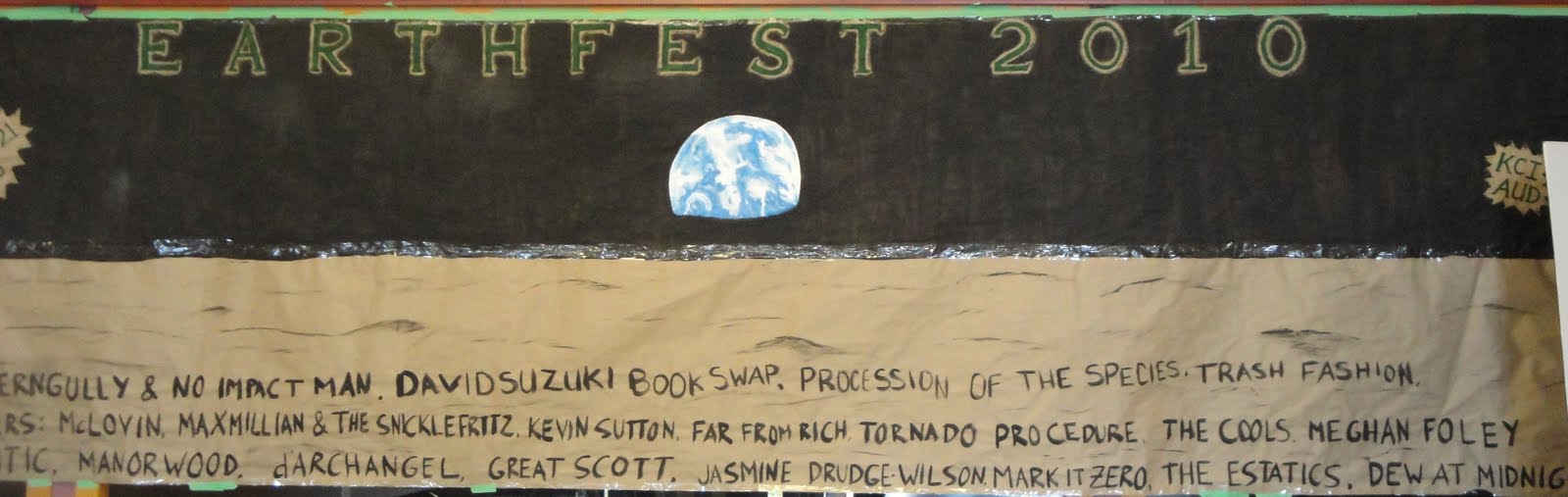

The Bad: The d'Archangel lead singer sprained his ankle mid-performance - yet kept on playing. Searching the school for a lost guitar was really depressing, so it was such a relief to find it had just been taken in error. The movies were barely attended.
The Ugly: Lots of people walked in without paying. We're in the hole over $200. One mic got taken - hopefully accidentally - which will raise that debt to over $300 if it can't be recovered. It's just five bucks, people!!
Next year ....
We'll have to relocate the ticket takers and make sure to get student volunteers who will rabidly watch who's coming and going and be willing to stop people from just walking by.
I need to make sure kids are on top of tasks they take on. For the most part, everyone did everything beautifully, but some advertising didn't happen because it was left too late, and teachers weren't being asked to supervise by the kids, they just happened to volunteer. We'll have to explore what stops kids from getting on these jobs - whether it's just general procrastination or is there some anxiety around it.
Showing No Impact Man again cost $100 for the rights, and only two people showed up to see it. Many of my neighbours had said they wanted to see it, but none came. We didn't get much of a turn-out last time either, and when we showed Wall-E last year, only one person came. The only person who watched Ferngully, was my daughter. I'm done with movie nights.
During the evening I had a chance to talk to a few people who have been there for every Earthfest. The first year we did it we threw everything together and hoped for the best, and it was huge. We had about twice as many people as we did this year. What did we do right that year? According to students, it's nothing we did or didn't do. It's the hippie factor. We're losing hippies like flies around here. I still wear long skirts with little jingly bells on the ties - I've got one on right now - but there's pretty much only one token hippie student left in the building. Why are only hippies associated with environmentalism anyway? There are lots of non-folk musicians who are all about the planet. Maybe next year our slogan could be:
Earthfest 2011: It's not just for hippies.
Okay, any better ideas out there??
below the fold
Subscribe to:
Posts (Atom)