Many standard-issue philosophers agree that happiness is predicated on an increase in pleasure and decrease in pain. Yet all too often the choices we make don’t lead towards our intended outcome of increased pleasure. We make choices that lead us towards misery. We want a clean world, but we drive everywhere. We want a strong uptown core, but we don’t stop shopping at Wal-Mart.....
Plato might say our problem is that we don’t have the skill of measurement and call for better education. Epicurus called the same thing a lack of prudence. And B.F. Skinner would agree that our immediate reinforcers or punishers seem much larger than distant rewards and punishments. It all boils down to a society full of people making poor choices. But I don't think it's entirely the case that people are unable to make wise choices. Some people measure well because they care more about making wise decisions while the rest just can’t be bothered to worry about long-term consequences. I think what makes the difference between those that measure well and those that don’t isn’t so much a skill they learned, but a personal disposition they inherited.
Most of the ancients insist that a citizen of any intelligence will prefer the joys of contemplation; sensuous entertainments are for the vulgar, the cretins or plebeians. But I wonder if we can be so quick to judge what different people enjoy because I believe what we find pleasurable to be largely innate. We are comfortable judging traits that we think are changeable: sloppiness or friendliness. We assign blame or praise for the actions associated with these characteristics. But we refrain from judgment of traits that are genetically determined: height, race, or gender. We might criticize someone for throwing like a girl (if we're willing to take on some feminist wrath) but typically not criticize her for being a girl as it’s largely unalterable.
But, since the genome project began, there are traits that were once seen as a choice and now are viewed more often as unalterable. Psychologists typically, hopefully, no longer try to convince gay men to go straight. Alcoholism is somewhat genetically predictable. And recent studies are insisting weight has less to do with diet than DNA. These are at once disempowering and comforting. It's not my fault, yet it's also not entirely within my control, if at all.
I propose that what we find pleasurable, what makes us happy, is determined by the axis of two dispositions: conscience and drive. My argument on the relationship between virtue and happiness rests on the premise that where we are on the continuum of each is primarily innate.
First, our conscience. At one end of the scale sit people with anti-social personality disorder. They have no desire towards kindness. If they want to get the privileges of freedom they can be trained to keep from harming others to avoid punishments, or they might just continue to harm and learn to avoid getting caught. But being kind just doesn't give them that warm-all-over glow. It's annoying. At the other end of the scale is the Mother Theresa type. They have a total and profound desire to act for the sake of others.
Regardless of the innate predisposition towards kindness or cruelty, we still have the free will to act against our basic personality. A psychopath could choose to be kind, and a Mother Theresa could choose to sell medical supplies for beer money, but these behaviours, while possible, wouldn’t make either happy. What makes them happy is not within their control.
Most of us are in the middle of these two ends. Personally, knowing the destruction consumerism takes on the environment or about specific companies that are exploiting or otherwise harming people, I avoid shopping, and shop carefully when necessary. But I will happily drive four hours to a cabin for yet another weekend away. The twinge of guilt I might feel about the amount of pollution I'm creating is no match for the enjoyment of the trip. And since it’s not my car, and I’ve never even owned a car, I can continue to foster and be praised for the illusion of extraordinary environmentalism, falling into the trap of loving honour more than loving the Good. I can be good to the environment worldwide, then add to the air pollution in my own province. I know what's right, what I should do, but I'm happy to add some future misery to my world. This is a complex continuum that dictates how happy we can be harming others, refraining from harm, and actively helping others.
Second for consideration is our drive, how much pleasure we get from our effort, from hard work. This is alluded to by Mill (and earlier by Nietzsche) in his acknowledgment that pleasure can come from excitement or tranquility. Those who prefer excitement are more willing to accept some pain in order to get a higher intensity of pleasure. They’ll work for their joys which could encompass anything from the physical pain of falling repeatedly trying to learn new skateboard tricks to the mental angst of struggling to understand a complex film or song. They get a rush from the challenge. They set their sights higher, but take a chance at greater disappointment or even death. People content with tranquility want less pain for their pleasures. They aim for security over intensity. They might prefer simpler, more mainstream art forms, and easier pastimes that are safe and effortless to enjoy, unable to grasp others’ intentional choice to actually be harmed for fun.
This continuum might also be useful for understanding relationships. The high drive type might be willing to tolerate, or enjoy even, arguments for the sake of a greater depth or intensity of relationship, and like existentialists, call their trials with knowledge of the self and other authenticity, and take, as a reward of sorts, a stance of superiority over those who can live without the angst. The more tranquil might lean towards a pleasant, low maintenance relationship, content with trivial discourse, careful not to rile anyone up with pointed questions. This type might be considered painfully dull by a someone seeking greater intensity. Some philosophies, like Taoism, suggest we should be able to see all people as equally valuable and interesting. But the Tao is not a philosophy for the driven.
The axis of these two innate behaviours, and some very generalized personality derivatives, might look something like this:
Low Drive with Weak Conscience: hedonist
Low Drive with Strong Conscience: kind when it's convenient to be so
High Drive with Weak Conscience: criminal
High Drive with Strong Conscience: activist
The generally kind person will avoid harming and try to help when it’s convenient. They’ll donate money if you come to their door, but they won’t go out of their way to learn about your cause or rally with you. The hedonist will take what they can as it comes their way. They’ll make just enough cash to get drunk on the weekend. The criminal group (including some CEOs) will work hard towards increasing their own profits regardless of harm it might cause others. And the activists will work hard to try to change the world and fire up all the others groups.
I won’t hazard a guess at the number of people that fit each category except to suggest that the high drive, strong conscience group is in the minority. That it’s difficult to get the majority of students in my eco-club, possibly the most environmentally concerned students in the school, to bring garbageless lunches once a week, supports this suggestion. Of course they care, but only if the tasks are relatively effortless.
There are two implications to this position: if what makes us happy is out of our control, then it can’t be judged nor altered. But we do praise Mother Theresa regardless how much joy she happens to get from her acts. And even if we feel a bit bad for a heartless killer with a troubled past, we do condemn a psychopath even if he’s unable to change. Like having an alcoholic co-worker who's constantly late for work, because we can understand why he acts in a manner that harms others, we can better understand his actions, but this understanding doesn’t excuse the behaviours.
It's just a chance luck-of-the-draw whether we’re born to enjoy harming or helping, but society can only survive if we chastise harm. We can look down on the corporate executive that exploits slave labour because he’s making a buck off their backs. It may not be his fault that this is what gives him pleasure, but it’s just unfortunate for him that his pleasure is not entirely applauded by our culture – well, by the few that care and have the will to mention it. And the Mother Theresas of the world are just lucky that what they enjoy brings honour. It’s similar to our aesthetic appeal to others. It’s genetically determined, but we still bear the burden that comes with our appearance for better or worse. Life isn’t fair.
But what’s worse is the second implication: that if what brings us pleasure isn’t controllable, and therefore can’t be altered, then it’s not possible to teach people to care about their actions, nor to motivate them to work for the benefit of the world. The activists can only create concern by making concern personally profitable, or by creating legislation that punishes exploitation harshly. And they can only motivate by making changes convenient for people, more convenient than the system they’re already used to. If we really want people to drive less, we need busses to stop right outside their doors and be free of charge. If we want students to compost, we have to walk by their food-filled hands with a green bucket at the ready.
For the activists, being happy and being virtuous is the same thing. For the criminals, it’s the opposite. They can only be moral or happy. The former group gets the honour, but the latter gets the cash.
below the fold
Wednesday, June 9, 2010
Thursday, June 3, 2010
Can We Get Patrick Duffy on the Phone?
I haven't written in a long while partly because I'm contemplating taking it all apart. The whole point of the blog is to share what students are doing at my school, and my hope was others would share what's happening at their schools too. I might just find a student rep to post here regularly in September. I'm not sure I'm allowed to say much of anything anymore, but perhaps I'll keep sharing, a bit more censored, until someone complains.
But I'm also not saying much partly because the environmental issues right now are too devastating to think about. La la la I can't hear you. But now that James Cameron's there to save the day, we can all rest easy - or at least laugh at bit at the circus unfolding before us. "Those morons don't know what they're doing," he laments, and lucky for us he knows some "really, really, really smart people" who can help. You can tell he's a master at writing dialogue....
Although I have to admit I agree with him here: "The government really needs to have its own independent ability to go down there and image the site, survey the site and do its own investigation....Because if you're not monitoring it independently, you're asking the perpetrator to give you the video of the crime scene." If the government doesn't set controls on corporations and act on the atrocities committed around the world in the name of profits, the environment doesn't stand a chance. In Nigeria, oil from corroded pipelines spew into the delta with little press or concern - so far, right this minute, the Niger's delta's got more oil in it than the gulf of Mexico. In a way, it's lucky the BP accident happened where it did. Otherwise, we'd completely ignore it.
Here's some Daily Show and Colbert Report to keep us going.
below the fold
But I'm also not saying much partly because the environmental issues right now are too devastating to think about. La la la I can't hear you. But now that James Cameron's there to save the day, we can all rest easy - or at least laugh at bit at the circus unfolding before us. "Those morons don't know what they're doing," he laments, and lucky for us he knows some "really, really, really smart people" who can help. You can tell he's a master at writing dialogue....
Although I have to admit I agree with him here: "The government really needs to have its own independent ability to go down there and image the site, survey the site and do its own investigation....Because if you're not monitoring it independently, you're asking the perpetrator to give you the video of the crime scene." If the government doesn't set controls on corporations and act on the atrocities committed around the world in the name of profits, the environment doesn't stand a chance. In Nigeria, oil from corroded pipelines spew into the delta with little press or concern - so far, right this minute, the Niger's delta's got more oil in it than the gulf of Mexico. In a way, it's lucky the BP accident happened where it did. Otherwise, we'd completely ignore it.
Here's some Daily Show and Colbert Report to keep us going.
below the fold
Saturday, May 22, 2010
Access Denied
Apparently some teacher somewhere made a statement about girls playing on boys' teams, and it sparked controversy and outrage. So now our board has issued an edict that says, in part, "Comments by employees to any media, or in any public manner or forum, should not make direct reference to the student involved, including commenting on her athletic abilities, characteristics, motives or her family." They want direct permission from parents to say or show anything about any student each time something comes up. Those general forms we get signed at the beginning of the year about taking photos of students don't hold water anymore....
So now I think I have to delete much of this blog, specifically all the photos and videos that include students like the Before It's Too Late video letter to Harper. And I imagine I have to delete the You Tube videos that show students commenting on their environmental views. Do I also have to delete the You Tube videos of my daughter and her friends doing a drama presentation since they they are students at my school? Does this mean I can't share videos or photos of my kids and their friends on-line in any way because they go to the school where I teach?? I tend to save thing on-line so I don't have to worry about fire burning down the photo albums or my hard-drive crashing. This determination removes this right from any parents who are teachers with their own children attending their school or friends with students at their school.
As far as I can understand, all this is fair game if it's added by one of my kids or students and not me. The kids are free to post videos and photos of themselves with their friends; only sharing by teachers is limited.
I tend to hate blanket statements in general because they're often too stringent in some circumstances yet allow for abuses in other arenas. This is no exception. It's reasonable to prevent teachers from slamming students publicly, but we're now prevented from celebrating students in a public format as well. And teachers who are truly corrupted will continue to post under the cover of anonymity.
It's ironic that this is all happening at the same time as Facebook is being allowed in the schools. YouTube, with all its educational shorts, is still not permitted, but we can make Facebook groups for our clubs and teams and classes, even though we're still discouraged from e-mailing students directly.
I'm in the middle of creating a video on what KCI has done as an EcoSchool this year. It'll be shown at the EcoFest in June for select teacher and students, but it can't be shown here - unless, of course, one of my students adds it.
below the fold
So now I think I have to delete much of this blog, specifically all the photos and videos that include students like the Before It's Too Late video letter to Harper. And I imagine I have to delete the You Tube videos that show students commenting on their environmental views. Do I also have to delete the You Tube videos of my daughter and her friends doing a drama presentation since they they are students at my school? Does this mean I can't share videos or photos of my kids and their friends on-line in any way because they go to the school where I teach?? I tend to save thing on-line so I don't have to worry about fire burning down the photo albums or my hard-drive crashing. This determination removes this right from any parents who are teachers with their own children attending their school or friends with students at their school.
As far as I can understand, all this is fair game if it's added by one of my kids or students and not me. The kids are free to post videos and photos of themselves with their friends; only sharing by teachers is limited.
I tend to hate blanket statements in general because they're often too stringent in some circumstances yet allow for abuses in other arenas. This is no exception. It's reasonable to prevent teachers from slamming students publicly, but we're now prevented from celebrating students in a public format as well. And teachers who are truly corrupted will continue to post under the cover of anonymity.
It's ironic that this is all happening at the same time as Facebook is being allowed in the schools. YouTube, with all its educational shorts, is still not permitted, but we can make Facebook groups for our clubs and teams and classes, even though we're still discouraged from e-mailing students directly.
I'm in the middle of creating a video on what KCI has done as an EcoSchool this year. It'll be shown at the EcoFest in June for select teacher and students, but it can't be shown here - unless, of course, one of my students adds it.
below the fold
Monday, May 10, 2010
Students Gone Wild
I've been dwelling for days on the article in the Record last weekend about students taking liberties on Albert Street. Students are exposing themselves, urinating publicly, vomiting on the sidewalk, wandering on people's property, and simulating masturbation in front of shocked neighbours all in broad daylight. When I first left home, my mom told me to never do anything I wouldn't want published on the front page of the paper. Today, she'd update that to a Facebook warning. But some of these guys posed for a photo.....
We had a student house in our neighbourhood until recently. One of the ladies that lived there left the house one day with some friends, got about three houses away, and squatted to pee on the boulevard in front of a family with kids sitting on the porch maybe ten feet away.
I was a student once, 25 years ago, and came away from it with many good stories. University is a time for people to develop into leaders, but part of that might include periods of devolving into animals. It's their first time away from home, and they need to feel wild and unconstrained. It's a ritually liminal period in their shift from child to adult. It's a time to push at boundaries. But we're in big trouble if society doesn't push back strongly and consistently to restrain the acts of excess. We need the energy and vibrancy of students in our city, but students need some help reigning it in.
Back in the day, we had boundaries. And in retrospect, it was the cops that set them firmly for us.
One letter to the editor on this issue is from a police officer who points a finger at Waterloo city council for not implementing stronger bylaws that can put a stop to this kind of behaviour. The neighbours also claim the city is responsible for for the problem because they allowed too many lodging houses on one street in the first place. I second Peter Foy's plea for tougher bylaws in the city.
As a student in the early 80s, I shared a house with a bunch of guys not too dissimilar from the type currently living on Albert Street. The difference is that anytime we had a party, the cops would show up at 11:00 to issue a $200 fine. At $3.35/hour, that was a week and a half's pay. Worse than that, if we didn't shut things down, they'd be back thirty minutes later with another fine to add to the first one. Typically, at the second visit, they'd just stay until the house was empty constantly threatening more fines if we took too long.
We still had parties, but only three or four a year. We couldn't afford to have more than that. The rest of the time we kept it quiet, sent the rowdies packing early on, and stayed indoors.
Perhaps a $600 fine issued every thirty minutes, and arrests made for every single act of public indecency and public urination would help curb the partying. Granted the bylaws need more teeth, and we'll likely need a few more officers on the force for an initial crack-down. I think it's worth it for the reputation, not just of the neighbourhood or the universities, but of my city.
This is one of those situations where I'm reminded of the famous lines by Martin Niemoller that sometimes starts, "First they came for the Jews...". It's not enough for one small group of neighbours to take on city hall; they need backing from all of us. If you have thoughts on the issue, take five minutes to phone or e-mail Brenda Halloran.
But beyond the potential solutions, one line of reasoning from the students in the article really bothered me: "It's not like we do it every single night....We throw a party here and there, but who doesn't?" These students believe they have a right to behave like this.
If I was a neighbour, I might go vigilante and arm myself with a digital camera and a facebook site: "Students who don't really want a good job." Some will wear it as a badge of honour and spend their lives explaining the late fees policy on movie rentals Other will recognize the importance of reputation, not just as a potential employee, but as a representative of their school, their city, and their family.
If I was part of the university admin, I'd might even go one step further than the fines and arrests to try to amend the policy of both universities to say that any students involved in parties that get a noise complaint charge will be temporarily suspended from studies and have to spend that time in a grade 10 civics class to learn the concept of rights and responsibilities.
I had a few students in my own class complain that some professors won't let students on facebook during class. Their argument was similar to the students involved in the parties: If they're paying to be there, they should be allowed to do whatever they want. They added that they learn better if they're multi-tasking, despite opposing claims by current research on the topic. Really they just haven't developed the ability to sustain their attention, to cope with moments of boredom, or at least to listen politely if not attentively. And we're back to that marshmallow test.
I think we have a responsibility as educators to ensure that, by their late teens, everyone grasps that they can't do anything that markedly affects the happiness of others. They can't yell in the streets whenever the mood strikes because it bothers other people who have the right to peace and quiet. And they can't surf the net during class because it might be distracting for others - not to mention rude to the professor. And they can't pee on my boulevard because I don't want to see that.
And they can't clear-cut rainforests in Brazil to grow soy beans for McDonalds beef because it destroys habitat and the world's best carbon-absorbers, or drain the water from the aquifers in India to make Coke because it leaves entire villages without clean drinking water, or fail to check equipment sufficiently to prevent a devastating oil leak because... what a mess.
It's all the same behaviour that says, "My desires matter more than your rights." And it's wrong.
below the fold
We had a student house in our neighbourhood until recently. One of the ladies that lived there left the house one day with some friends, got about three houses away, and squatted to pee on the boulevard in front of a family with kids sitting on the porch maybe ten feet away.
I was a student once, 25 years ago, and came away from it with many good stories. University is a time for people to develop into leaders, but part of that might include periods of devolving into animals. It's their first time away from home, and they need to feel wild and unconstrained. It's a ritually liminal period in their shift from child to adult. It's a time to push at boundaries. But we're in big trouble if society doesn't push back strongly and consistently to restrain the acts of excess. We need the energy and vibrancy of students in our city, but students need some help reigning it in.
Back in the day, we had boundaries. And in retrospect, it was the cops that set them firmly for us.
One letter to the editor on this issue is from a police officer who points a finger at Waterloo city council for not implementing stronger bylaws that can put a stop to this kind of behaviour. The neighbours also claim the city is responsible for for the problem because they allowed too many lodging houses on one street in the first place. I second Peter Foy's plea for tougher bylaws in the city.
As a student in the early 80s, I shared a house with a bunch of guys not too dissimilar from the type currently living on Albert Street. The difference is that anytime we had a party, the cops would show up at 11:00 to issue a $200 fine. At $3.35/hour, that was a week and a half's pay. Worse than that, if we didn't shut things down, they'd be back thirty minutes later with another fine to add to the first one. Typically, at the second visit, they'd just stay until the house was empty constantly threatening more fines if we took too long.
We still had parties, but only three or four a year. We couldn't afford to have more than that. The rest of the time we kept it quiet, sent the rowdies packing early on, and stayed indoors.
Perhaps a $600 fine issued every thirty minutes, and arrests made for every single act of public indecency and public urination would help curb the partying. Granted the bylaws need more teeth, and we'll likely need a few more officers on the force for an initial crack-down. I think it's worth it for the reputation, not just of the neighbourhood or the universities, but of my city.
This is one of those situations where I'm reminded of the famous lines by Martin Niemoller that sometimes starts, "First they came for the Jews...". It's not enough for one small group of neighbours to take on city hall; they need backing from all of us. If you have thoughts on the issue, take five minutes to phone or e-mail Brenda Halloran.
But beyond the potential solutions, one line of reasoning from the students in the article really bothered me: "It's not like we do it every single night....We throw a party here and there, but who doesn't?" These students believe they have a right to behave like this.
If I was a neighbour, I might go vigilante and arm myself with a digital camera and a facebook site: "Students who don't really want a good job." Some will wear it as a badge of honour and spend their lives explaining the late fees policy on movie rentals Other will recognize the importance of reputation, not just as a potential employee, but as a representative of their school, their city, and their family.
If I was part of the university admin, I'd might even go one step further than the fines and arrests to try to amend the policy of both universities to say that any students involved in parties that get a noise complaint charge will be temporarily suspended from studies and have to spend that time in a grade 10 civics class to learn the concept of rights and responsibilities.
I had a few students in my own class complain that some professors won't let students on facebook during class. Their argument was similar to the students involved in the parties: If they're paying to be there, they should be allowed to do whatever they want. They added that they learn better if they're multi-tasking, despite opposing claims by current research on the topic. Really they just haven't developed the ability to sustain their attention, to cope with moments of boredom, or at least to listen politely if not attentively. And we're back to that marshmallow test.
I think we have a responsibility as educators to ensure that, by their late teens, everyone grasps that they can't do anything that markedly affects the happiness of others. They can't yell in the streets whenever the mood strikes because it bothers other people who have the right to peace and quiet. And they can't surf the net during class because it might be distracting for others - not to mention rude to the professor. And they can't pee on my boulevard because I don't want to see that.
And they can't clear-cut rainforests in Brazil to grow soy beans for McDonalds beef because it destroys habitat and the world's best carbon-absorbers, or drain the water from the aquifers in India to make Coke because it leaves entire villages without clean drinking water, or fail to check equipment sufficiently to prevent a devastating oil leak because... what a mess.
It's all the same behaviour that says, "My desires matter more than your rights." And it's wrong.
below the fold
Labels:
Activism,
Debate This,
Eco-Thoughts,
In the News,
Waterloo Region
Sunday, May 2, 2010
Green Bin Awareness
My letter to the editor was published in yesterday's paper following a report that some are thinking about banning organics from landfill in the region. It's hard to put everything in 200 words - for me anyway as some regular readers might have noticed my long- winded nature - but I think I could have been clearer yet.
I think it most important to make everyone aware that what goes in the green bin ends up sold as fertilizer, largely to be sprayed on crops. People who complain that we can't line the bins with plastic bags completely miss this point. Even the city encourages us to include microwave popcorn bags and Tim Hortons cups in the mix, but I don't want to be eating the plastic and teflon in those. Dog crap is bad enough! They heat the sludge to extreme temperatures to kill off bacteria, but there a reason spinach was on the watch list for e-coli. E-coli hangs out in sludge, and it's not always entirely destroyed by processing. But there's no way to get the phthalates, PBAs, and perfluorinated compounds out of the final product. If no animal in their right mind would want to eat it, don't put it in the bin!!
So far we don't have control over that, so wash your produce well, as always, and, even better, get to know the practices of the farmers that feed you.
And I really wonder how the city will regulate what goes in the landfill. People still put cardboard in there even though there's been a bylaw against it for years.
below the fold
I think it most important to make everyone aware that what goes in the green bin ends up sold as fertilizer, largely to be sprayed on crops. People who complain that we can't line the bins with plastic bags completely miss this point. Even the city encourages us to include microwave popcorn bags and Tim Hortons cups in the mix, but I don't want to be eating the plastic and teflon in those. Dog crap is bad enough! They heat the sludge to extreme temperatures to kill off bacteria, but there a reason spinach was on the watch list for e-coli. E-coli hangs out in sludge, and it's not always entirely destroyed by processing. But there's no way to get the phthalates, PBAs, and perfluorinated compounds out of the final product. If no animal in their right mind would want to eat it, don't put it in the bin!!
So far we don't have control over that, so wash your produce well, as always, and, even better, get to know the practices of the farmers that feed you.
And I really wonder how the city will regulate what goes in the landfill. People still put cardboard in there even though there's been a bylaw against it for years.
below the fold
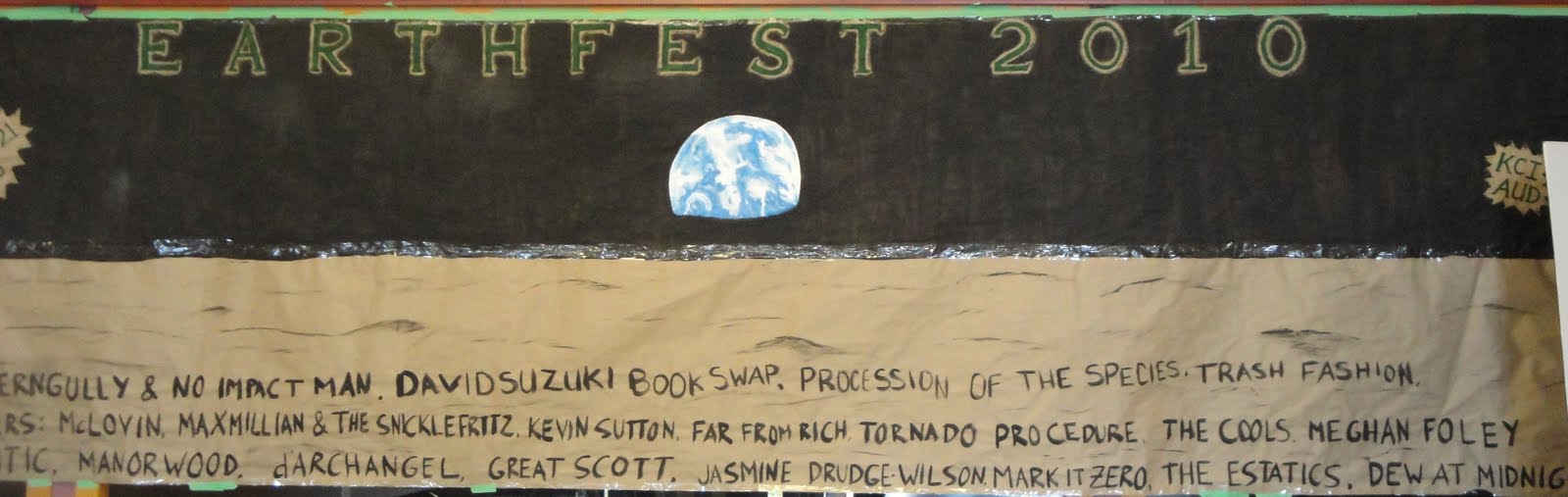
Earthfest 2010 - The Performers
During the evening I took a few minutes of footage from each performer. I cut it down to the best bits in two 10-minuted chunks (because nothing on YouTube can be longer than 10 minutes). Next year, we'll film the whole thing and I'll make one 10 minute video of a bit of everything, and then upload every band separately. I'll need another person on camera for that. Some people got ripped off for film time because I got really busy during a few sets. I thought I'd be fine without a tripod, but I should have taken five minutes to get one because the camera's pretty shaky and jerky in parts. I tried to get every band member but wasn't always successful because the "mosh pit" was full of people or because it just didn't happen. And I got mesmerized watching some of the more energetic bits of some bands, then only caught the calmer bits on film.
Nevertheless, for a flavour of each band and a teaser for next year's Earthfest, here's Earthfest 2010:
below the fold
Nevertheless, for a flavour of each band and a teaser for next year's Earthfest, here's Earthfest 2010:
below the fold
Monday, April 26, 2010
KCI Waste Audit
I had my class do our final waste audit of the year. I hate plastic gloves, so I just get in there with bare hands. Nothing icked me out until someone asked me, "What do I do with this?" and I took it without looking, and it was... dun dun da.... a cigarette pack! I made involuntary "ew" noises as I removed the inner foil to put the boxboard in the recycling.
We separated all the garbage into recycling containers and clear garbage bags, then weighed each type of garbage separately. Here's our final tally...

Compost: We have 3 compost buckets out where people are supposed to be eating, but we can't put any out where they often eat even though they shouldn't. So there was a lot of compost. In September we weighed 11.4 pounds*, but this time it was 53.8 pounds. Now the big part of that was two big heavy bags of yard waste that custodians were pitching. This is an issue. We're not supposed to ask custodians to do anything to help us because they're seriously understaffed, but how much more work is it to take yard waste to the composter instead of the garbage bin? It's likely the same number of steps. It's just one more thing to think about, though. But surely we can solve this dilemma. It's ironic because I need yard waste to layer with food waste, and we never have enough, so I bring it from home! And the custodians just pitch it. Funny that. So three bins full plus two bags. They all went into the compost bin. Today anyway. RETRACTION: Apparently it's NOT the custodians at all - but we can't seem to find out where those two bags came from. It could be student volunteers that need a bit more training.
Recycling: There are blue boxes for paper and white buckets for cans and bottles all over the school yet last September we found 112.5 pounds of recycling in the garbage. Much of that was a pile of books someone had tossed - likely a teacher because many were dictionaries. We cleaned them up and put them in the free store and they found better homes within a day. This time we had 30.2 pounds of recycling. Better by comparison, but still. There were 20.2 pounds of bottles and cans which completely filled a big blue bin (bottles and cans are really light - 20 pounds is a lot), and 10.0 pounds of paper which almost overflowed one blue box.
Single-Use Cups: Last September we tossed 5.4 pounds of them in one day. That absolutely astounds me. This time, 5.6 pounds. Maybe I'll get the OneEarth kids to campaign at local Tims to try to get people to buy and use travel mugs. They're less than $5, and you get cheaper coffee each time you use one. In fact, if you use one every day, it works out to a free coffee every 14 days!! That's better odds than you get with roll-up-the-rim campaigns. I wonder if I could convince them to stand out at a Tims before school every morning for a week around earth day next year - just talking to people and trying to persuade them. Or maybe this year yet.
Potential Green Bin Waste: We applied to be part of the green bin pilot project. If we get it, according to this one day of garbage, we'll be able to defer 17.8 pounds of garbage. Last September it was 16.5 pounds. This includes all the food waste that can't go in our compost - meats, oils, cheeses... and gross paper towels and kleenexes. It was disheartening to see how much food people throw out. For the parents out there, lots of complete lunches are going in the trash. It'd be nice to set up some kind of "extra food" lunch program where people could take their lovingly-made lunches for other people to eat. Untouched apples, oranges, and bananas, unopened granola bars and yogurts, perfectly wrapped sandwiches... Hmmm... there's got to be a way to save this stuff from the trash. Maybe I'll just set up a little table with a sign that says, "I just can't eat all this - go for it!" and instructions to leave unwanted food for the taking. Like the free store, but with food. I have a gut feeling there's some law or other that will stop this from happening, but it's easier to beg forgiveness than permission.
Packaging: This is what I consider real garbage. This is stuff that we can't do anything with because the materials to make it are mixed together in such a way that they can't be un-mixed and re-used or recycled, and we had bags and bags of the stuff. Foil/plastic wrappers from granola bars, fruit-to-go, chocolate bars, chips, candy, and the like. In September we had 80.4 pounds, and this time around it was 81.8 pounds. Pretty consistent. Consistently crappy! 80 pounds of wrappers that are each light as air is a truck-load of wrappers! Well, six big bags anyway. The only way we can prevent this is to convince parents not to buy the stuff. But I'm guilty of that one. I hate making lunches, and anything that makes it easier is going to happen. We could also take the junk-food vending machines out of the schools. If schools stopped selling junk to kids, we'd have less packaging in the garbage. Some would walk to the store at lunch to buy crap, but at least they're getting exercise at the same time!
Other: Cardboard is illegal to put in the landfill, but it's always in our garbage. The big problem is the boxes our pizzas and similar stuff comes in. And I included in this total all the bags used by the custodians because they don't dump one can into another, they take every bag out of every can every day. That was over two pounds of bags on its own. In total, last September we had 9.8 pounds, last week it was 12.6 pounds.
All in all we reduced our garbage by 15% since September, but somehow I don't feel like celebrating. We made a video about recycling and composting, and immediately I noticed a difference in the amount of compost in the bins. Now it plays regularly. We also put signs on garbage to remind people what NOT to put in there. In the one day of waste auditing we took out 43% of our waste for composting or recycling. If people could pay attention to where they're tossing their garbage, we could cut our landfill dumping by almost half!
Here's all the helpful students who learned how to sort garbage:
Tomorrow is the energy audit, and we'll weigh all the recycling - what actually gets put in there.
*I set the scales for pounds because I still don't have a feel for kilograms. They are meaningless to me.
below the fold
We separated all the garbage into recycling containers and clear garbage bags, then weighed each type of garbage separately. Here's our final tally...
Compost: We have 3 compost buckets out where people are supposed to be eating, but we can't put any out where they often eat even though they shouldn't. So there was a lot of compost. In September we weighed 11.4 pounds*, but this time it was 53.8 pounds. Now the big part of that was two big heavy bags of yard waste that custodians were pitching. This is an issue. We're not supposed to ask custodians to do anything to help us because they're seriously understaffed, but how much more work is it to take yard waste to the composter instead of the garbage bin? It's likely the same number of steps. It's just one more thing to think about, though. But surely we can solve this dilemma. It's ironic because I need yard waste to layer with food waste, and we never have enough, so I bring it from home! And the custodians just pitch it. Funny that. So three bins full plus two bags. They all went into the compost bin. Today anyway. RETRACTION: Apparently it's NOT the custodians at all - but we can't seem to find out where those two bags came from. It could be student volunteers that need a bit more training.
Recycling: There are blue boxes for paper and white buckets for cans and bottles all over the school yet last September we found 112.5 pounds of recycling in the garbage. Much of that was a pile of books someone had tossed - likely a teacher because many were dictionaries. We cleaned them up and put them in the free store and they found better homes within a day. This time we had 30.2 pounds of recycling. Better by comparison, but still. There were 20.2 pounds of bottles and cans which completely filled a big blue bin (bottles and cans are really light - 20 pounds is a lot), and 10.0 pounds of paper which almost overflowed one blue box.
Single-Use Cups: Last September we tossed 5.4 pounds of them in one day. That absolutely astounds me. This time, 5.6 pounds. Maybe I'll get the OneEarth kids to campaign at local Tims to try to get people to buy and use travel mugs. They're less than $5, and you get cheaper coffee each time you use one. In fact, if you use one every day, it works out to a free coffee every 14 days!! That's better odds than you get with roll-up-the-rim campaigns. I wonder if I could convince them to stand out at a Tims before school every morning for a week around earth day next year - just talking to people and trying to persuade them. Or maybe this year yet.
Potential Green Bin Waste: We applied to be part of the green bin pilot project. If we get it, according to this one day of garbage, we'll be able to defer 17.8 pounds of garbage. Last September it was 16.5 pounds. This includes all the food waste that can't go in our compost - meats, oils, cheeses... and gross paper towels and kleenexes. It was disheartening to see how much food people throw out. For the parents out there, lots of complete lunches are going in the trash. It'd be nice to set up some kind of "extra food" lunch program where people could take their lovingly-made lunches for other people to eat. Untouched apples, oranges, and bananas, unopened granola bars and yogurts, perfectly wrapped sandwiches... Hmmm... there's got to be a way to save this stuff from the trash. Maybe I'll just set up a little table with a sign that says, "I just can't eat all this - go for it!" and instructions to leave unwanted food for the taking. Like the free store, but with food. I have a gut feeling there's some law or other that will stop this from happening, but it's easier to beg forgiveness than permission.
Packaging: This is what I consider real garbage. This is stuff that we can't do anything with because the materials to make it are mixed together in such a way that they can't be un-mixed and re-used or recycled, and we had bags and bags of the stuff. Foil/plastic wrappers from granola bars, fruit-to-go, chocolate bars, chips, candy, and the like. In September we had 80.4 pounds, and this time around it was 81.8 pounds. Pretty consistent. Consistently crappy! 80 pounds of wrappers that are each light as air is a truck-load of wrappers! Well, six big bags anyway. The only way we can prevent this is to convince parents not to buy the stuff. But I'm guilty of that one. I hate making lunches, and anything that makes it easier is going to happen. We could also take the junk-food vending machines out of the schools. If schools stopped selling junk to kids, we'd have less packaging in the garbage. Some would walk to the store at lunch to buy crap, but at least they're getting exercise at the same time!
Other: Cardboard is illegal to put in the landfill, but it's always in our garbage. The big problem is the boxes our pizzas and similar stuff comes in. And I included in this total all the bags used by the custodians because they don't dump one can into another, they take every bag out of every can every day. That was over two pounds of bags on its own. In total, last September we had 9.8 pounds, last week it was 12.6 pounds.
All in all we reduced our garbage by 15% since September, but somehow I don't feel like celebrating. We made a video about recycling and composting, and immediately I noticed a difference in the amount of compost in the bins. Now it plays regularly. We also put signs on garbage to remind people what NOT to put in there. In the one day of waste auditing we took out 43% of our waste for composting or recycling. If people could pay attention to where they're tossing their garbage, we could cut our landfill dumping by almost half!
Here's all the helpful students who learned how to sort garbage:
Tomorrow is the energy audit, and we'll weigh all the recycling - what actually gets put in there.
*I set the scales for pounds because I still don't have a feel for kilograms. They are meaningless to me.
below the fold
Sunday, April 25, 2010
Earthfest Info Displays
For old grads, this is the very same t-shirt sign used at every Earthfest since the beginning!
On top of the music and artwork and jewelry sales, we create some information displays.....
You can click on the images to make them bigger. One just focused on single-use coffee cups. KCI throws out 5.6 kilograms of them every single day. That's outrageous. We had two different tables of travel mugs for sale, and a big bag of one day's use of cups.
But one of my favourite things that we did was to cut out star shapes from re-use-it paper, and people were encouraged to write an answer to one of these questions: What's on your eco-conscious (eco-guilt) or what did you do for the earth today (eco-good). They stuck them on the night sky of the banner, and it really filled in by the end. I've got close-ups of each star for the video (still in progress). I got the idea from Franke James, and I'm going to see if we can modify it further for our earth workshop at a Empire Public School on May 12th. Any other great ideas to do with the environment and little ones, please let me know!
below the fold
Labels:
architecture,
Earth Day 2010,
Earthfest,
Tim Hortons,
Toxins
Envirothon Team of 2010
We made it to fourth place in the Envirothon this year which is amazing considering it's our first time, and it took until the end of the competition to really get my head around how it works. WCI won again.
Here's photos of the event and some how-to notes for anyone interested in running a team at their school next year....
Your team will compete against others in the region, then maybe move to the provincials, and the international competition this year is being held in California for several weeks of July. The students have to be extraordinarily self-motivated because they really have to learn all the information provided on the website. I didn't take that seriously enough soon enough. Parts of that website aren't accessible until you sign up officially - I guess so you don't cheat and start memorizing it in the summer. In our region, they offer three fantastic workshops before the actual competition day, so plan to miss four days spread out over the course of the year. Also plan to borrow or rent or own a van that can transport the students. It's handy if a few of them have their G and can drive one another.
If you want to do it at all, get the team together in the first week of school. I started late this year and missed out on the first really useful workshop. You need five people in a team, but it's good to have more in case someone is sick the day of the competition. If you have enough people, you can submit two teams. I tried to get each person to learn two sections of the material so they'd be able to cover each other, but there's so much information, that didn't really happen.
The material is divided into five sections: soil, forestry, wildlife, aquatics, and a special topic which was groundwater this year. By know everything I mean be able to identify what layer of soil a sample was taken from, label trees from a row of cut branches with the buds just starting on them, know all the types of bugs in the water and which ones indicate a healthy system, be able to label evidence of different kinds of animals and birds in a habitat, and lots, lots more! Try to get someone with a background in environmental science to help you run it if possible. My degree is in philosophy. I just like hanging out in the woods. I was pretty useless as an adviser, and I got lost driving to almost every workshop, but I enjoyed it and learned a ton.
For the competition, you'll go to four different stations in a forested area with some water running through it somewhere. At each station, the kids have 30 minutes to answer a test that often involves a hands-on component like collecting and labeling aquatic insects or measuring trees or estimating the number of trees in an area, or getting and labeling soil samples. Teachers aren't allowed to help or say anything all day - thank goodness. The special topic is tested through an 8 minute presentation that students have a chance to practice beforehand. I think everyone should set aside every day after school for a week before the competition to work on the presentation because it's worth a lot of marks. You only get the presentation question a week ahead of time, and you can't bring any notes or props or other material to the competition with you. Everything has to be memorized or made on the spot.
After it's all over, thank the organizers, but implore them to please please make the event environmentally friendly, because, dammit, if the environmentally interested find it too inconvenient to do, then we are truly doomed! During the competition, all the people working were handed Tim's coffees in single-use cups. Nary a travel mug in sight. And lunch was pizza on paper plates with bleached napkins. It's really easy to make a huge event no impact; check out the annual Hillside music festival to see it in action, but here's some basics:
1. Tell everyone who's coming to bring their own plates, napkins (cloth preferably, an arm-sleeve will do in a pinch), and cups. If you make it clear on every correspondence that no cups or plate will be provided people will bring their own or make do. Then follow through and actually save money by never using disposable products again!
2. If you're going on a Tim's run, have everyone put a bit of tape with their name and order on their mug. They can add this nicely to an area not often handled, and it can be permanent on their mug for the next time someone offers to buy them coffee. Take the mugs in, and just hand them off to be filled accordingly. No tracking of orders or remembering or writing it all down is necessary! And you did something nice for the world.
See how easy it is?!!
below the fold
Here's photos of the event and some how-to notes for anyone interested in running a team at their school next year....
Your team will compete against others in the region, then maybe move to the provincials, and the international competition this year is being held in California for several weeks of July. The students have to be extraordinarily self-motivated because they really have to learn all the information provided on the website. I didn't take that seriously enough soon enough. Parts of that website aren't accessible until you sign up officially - I guess so you don't cheat and start memorizing it in the summer. In our region, they offer three fantastic workshops before the actual competition day, so plan to miss four days spread out over the course of the year. Also plan to borrow or rent or own a van that can transport the students. It's handy if a few of them have their G and can drive one another.
If you want to do it at all, get the team together in the first week of school. I started late this year and missed out on the first really useful workshop. You need five people in a team, but it's good to have more in case someone is sick the day of the competition. If you have enough people, you can submit two teams. I tried to get each person to learn two sections of the material so they'd be able to cover each other, but there's so much information, that didn't really happen.
The material is divided into five sections: soil, forestry, wildlife, aquatics, and a special topic which was groundwater this year. By know everything I mean be able to identify what layer of soil a sample was taken from, label trees from a row of cut branches with the buds just starting on them, know all the types of bugs in the water and which ones indicate a healthy system, be able to label evidence of different kinds of animals and birds in a habitat, and lots, lots more! Try to get someone with a background in environmental science to help you run it if possible. My degree is in philosophy. I just like hanging out in the woods. I was pretty useless as an adviser, and I got lost driving to almost every workshop, but I enjoyed it and learned a ton.
For the competition, you'll go to four different stations in a forested area with some water running through it somewhere. At each station, the kids have 30 minutes to answer a test that often involves a hands-on component like collecting and labeling aquatic insects or measuring trees or estimating the number of trees in an area, or getting and labeling soil samples. Teachers aren't allowed to help or say anything all day - thank goodness. The special topic is tested through an 8 minute presentation that students have a chance to practice beforehand. I think everyone should set aside every day after school for a week before the competition to work on the presentation because it's worth a lot of marks. You only get the presentation question a week ahead of time, and you can't bring any notes or props or other material to the competition with you. Everything has to be memorized or made on the spot.
After it's all over, thank the organizers, but implore them to please please make the event environmentally friendly, because, dammit, if the environmentally interested find it too inconvenient to do, then we are truly doomed! During the competition, all the people working were handed Tim's coffees in single-use cups. Nary a travel mug in sight. And lunch was pizza on paper plates with bleached napkins. It's really easy to make a huge event no impact; check out the annual Hillside music festival to see it in action, but here's some basics:
1. Tell everyone who's coming to bring their own plates, napkins (cloth preferably, an arm-sleeve will do in a pinch), and cups. If you make it clear on every correspondence that no cups or plate will be provided people will bring their own or make do. Then follow through and actually save money by never using disposable products again!
2. If you're going on a Tim's run, have everyone put a bit of tape with their name and order on their mug. They can add this nicely to an area not often handled, and it can be permanent on their mug for the next time someone offers to buy them coffee. Take the mugs in, and just hand them off to be filled accordingly. No tracking of orders or remembering or writing it all down is necessary! And you did something nice for the world.
See how easy it is?!!
below the fold
Friday, April 23, 2010
Earthfest 2010 Wrap-Up
The Good: All the bands were amazing!! It was the best year ever for music. There wasn't a weak band in the batch. And Jasmine found her guitar again. Lots of old KCI grads came back to play and visit. More teachers than ever came to help or watch, and many stayed right until the very end to clean up. We sold 24 hand-painted t-shirts! We had a really good crowd. The facebook site has a few people pictures, and this one has a ton. Editing of the video I shot of every band and everything else is in progress. We were interviewed by CTV and Rogers. If anyone has a link to a clip, let me know!
The Bad: The d'Archangel lead singer sprained his ankle mid-performance - yet kept on playing. Searching the school for a lost guitar was really depressing, so it was such a relief to find it had just been taken in error. The movies were barely attended.
The Ugly: Lots of people walked in without paying. We're in the hole over $200. One mic got taken - hopefully accidentally - which will raise that debt to over $300 if it can't be recovered. It's just five bucks, people!!
Next year ....
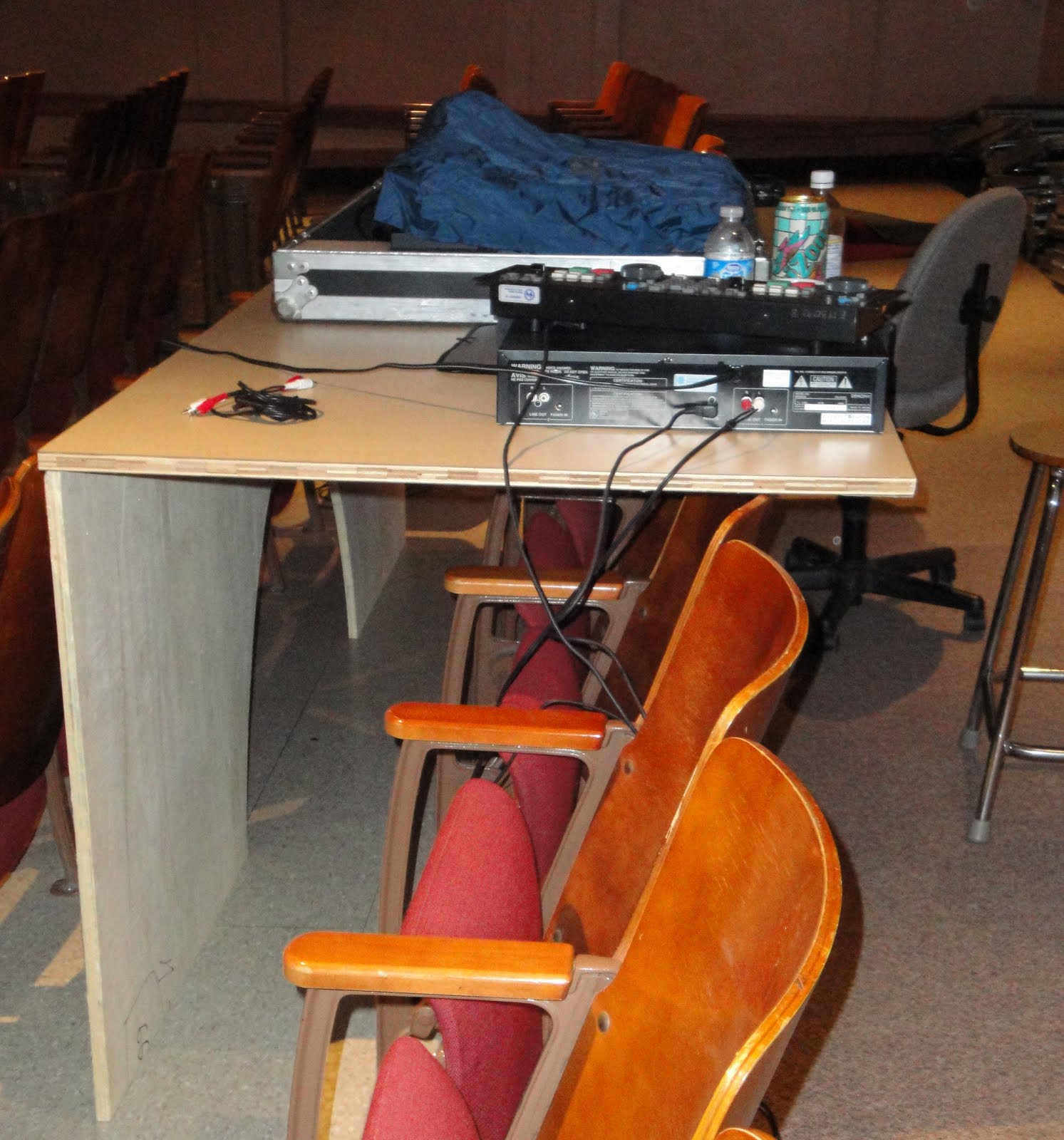
We're going to have to get bands to sell tickets, i.e. give us money upfront in exchange for tickets which they can sell to get their money back or just pitch and call it a donation or fee. We paid to rent an expensive sound board and sound guy - excellent but expensive - and several people don't want to go backwards to low quality sound. But I'd like to stop funding this adventure. Thanks to Mr. St. Cyr for building a cool sound system table to fit over the seats for little money and really fast! We can use it over and over for events like these. And thanks to Mr. Fricke and the tech crew for a perfect evening.
We'll have to relocate the ticket takers and make sure to get student volunteers who will rabidly watch who's coming and going and be willing to stop people from just walking by.
I need to make sure kids are on top of tasks they take on. For the most part, everyone did everything beautifully, but some advertising didn't happen because it was left too late, and teachers weren't being asked to supervise by the kids, they just happened to volunteer. We'll have to explore what stops kids from getting on these jobs - whether it's just general procrastination or is there some anxiety around it.
Showing No Impact Man again cost $100 for the rights, and only two people showed up to see it. Many of my neighbours had said they wanted to see it, but none came. We didn't get much of a turn-out last time either, and when we showed Wall-E last year, only one person came. The only person who watched Ferngully, was my daughter. I'm done with movie nights.
During the evening I had a chance to talk to a few people who have been there for every Earthfest. The first year we did it we threw everything together and hoped for the best, and it was huge. We had about twice as many people as we did this year. What did we do right that year? According to students, it's nothing we did or didn't do. It's the hippie factor. We're losing hippies like flies around here. I still wear long skirts with little jingly bells on the ties - I've got one on right now - but there's pretty much only one token hippie student left in the building. Why are only hippies associated with environmentalism anyway? There are lots of non-folk musicians who are all about the planet. Maybe next year our slogan could be:
Earthfest 2011: It's not just for hippies.
Okay, any better ideas out there??
below the fold
The Bad: The d'Archangel lead singer sprained his ankle mid-performance - yet kept on playing. Searching the school for a lost guitar was really depressing, so it was such a relief to find it had just been taken in error. The movies were barely attended.
The Ugly: Lots of people walked in without paying. We're in the hole over $200. One mic got taken - hopefully accidentally - which will raise that debt to over $300 if it can't be recovered. It's just five bucks, people!!
Next year ....
We're going to have to get bands to sell tickets, i.e. give us money upfront in exchange for tickets which they can sell to get their money back or just pitch and call it a donation or fee. We paid to rent an expensive sound board and sound guy - excellent but expensive - and several people don't want to go backwards to low quality sound. But I'd like to stop funding this adventure. Thanks to Mr. St. Cyr for building a cool sound system table to fit over the seats for little money and really fast! We can use it over and over for events like these. And thanks to Mr. Fricke and the tech crew for a perfect evening.
We'll have to relocate the ticket takers and make sure to get student volunteers who will rabidly watch who's coming and going and be willing to stop people from just walking by.
I need to make sure kids are on top of tasks they take on. For the most part, everyone did everything beautifully, but some advertising didn't happen because it was left too late, and teachers weren't being asked to supervise by the kids, they just happened to volunteer. We'll have to explore what stops kids from getting on these jobs - whether it's just general procrastination or is there some anxiety around it.
Showing No Impact Man again cost $100 for the rights, and only two people showed up to see it. Many of my neighbours had said they wanted to see it, but none came. We didn't get much of a turn-out last time either, and when we showed Wall-E last year, only one person came. The only person who watched Ferngully, was my daughter. I'm done with movie nights.
During the evening I had a chance to talk to a few people who have been there for every Earthfest. The first year we did it we threw everything together and hoped for the best, and it was huge. We had about twice as many people as we did this year. What did we do right that year? According to students, it's nothing we did or didn't do. It's the hippie factor. We're losing hippies like flies around here. I still wear long skirts with little jingly bells on the ties - I've got one on right now - but there's pretty much only one token hippie student left in the building. Why are only hippies associated with environmentalism anyway? There are lots of non-folk musicians who are all about the planet. Maybe next year our slogan could be:
Earthfest 2011: It's not just for hippies.
Okay, any better ideas out there??
below the fold
Wednesday, April 14, 2010
Digital Detox
Digital Detox Week starts on Monday. Try to go one week without computer, TV, cell phones, iPods, etc. I'm going to try starting tonight, mainly out of necessity. Life is extraordinarily busy right now. Don't forget to come to Earthfest 2010 on Wednesday night!
That's it!
below the fold
That's it!
below the fold
Tuesday, April 6, 2010
Solar Power Possibilities
Twenty-five coal miners died so we could have electricity. If you have ever considered putting some solar panels on your roof, now's the time. In Ontario, feed in tariffs (FITs) will pay for most home systems (under 10 kW). From the CREW site: A FIT contract pays Ontario generators of solar power $0.80 per kWh of electricity produced, as compared to the $0.07 +/- per kWh of electricity we pay our hydro utility for consumption of electricity, plus delivery and debt service charges = about $0.12 kWh for this community. A 2 kW PV system can generate up to $1700 per year of income and offset about 2 tonnes of greenhouse gas (GHG) emissions.
After all is said and done, with FIT, the prices are guaranteed for 20 years from the time you sign up, and your system will be paid off in about 10 or 12 years regardless of the size. But it's a limited time offer, and judging from the way the home-energy retrofit program was dumped without a word of warning, I'd get in there pretty soon.
Our hydro bills average to about 500 kWh/month which would require a 3.5 kW system (if I did all the many calculations right) which will cost about $35,000, but it's not really feeding the home's energy. It works by feeding the grid. So you still pay regular hydro bills, but you get cash back every month based on the amount of electricity your panels create. Really, just get whatever size of system you can comfortably afford regardless how much power you use. I wish I had read that bit before embarking on all that figuring!
The question is, after the 20 years, after the system is paid for, will the gov. dump the 80 cent payout and keep all that electricity homeowners are generating for free? I wouldn't put it past them. But if lots of us jump on this at least we'll need a lot fewer coal mines. And you can always convert the panels to produce off-grid later.
below the fold
Monday, April 5, 2010
Clean Cars or Clean Lakes? The Choice is Yours
While you're trying to drive less, think about how you wash your car. If you wash it on the driveway, all the gunk from the car and whatever soap you might use runs down the driveway and straight into the storm drains which go straight to the rivers which run into the lakes and eventually the oceans. Commercial car washes are actually very environmentally friendly in this respect. But if you really want to wash the car in the comforts of your own home, consider driving onto the lawn or garden. It'll give the yard some much needed watering, and plants, dirt, and rocks are handy for filtering toxins out of water before it hits groundwater levels.
AND keep in mind that biodegradable soap (anything for that matter) only biodegrades on land, not in the water. Keep soap 200 m away from a body of water when you're camping, and don't let it get into the storm drains! If you wouldn't want to drink it, keep it out of the water. And if you wouldn't dump it in a pristine lake, don't dump it down the storm drains or leave it on the ground to make its way there - ahemcigarettebuttsahem. It's not just about the environment, it's basic common courtesy not to trash what isn't yours.
Just sayin'. That's it.
below the fold
AND keep in mind that biodegradable soap (anything for that matter) only biodegrades on land, not in the water. Keep soap 200 m away from a body of water when you're camping, and don't let it get into the storm drains! If you wouldn't want to drink it, keep it out of the water. And if you wouldn't dump it in a pristine lake, don't dump it down the storm drains or leave it on the ground to make its way there - ahemcigarettebuttsahem. It's not just about the environment, it's basic common courtesy not to trash what isn't yours.
Just sayin'. That's it.
below the fold
Balance?
I was talking with a neighbour about her teenaged daughter's rabid environmentalism. She told me she has to keep reminding her that it's all about balance. Balance. We have to stay balanced...I didn't say much because she was unaware of my own rabid environmentalism, but I wonder what she meant by balance. Do we need a balance between consumerism and contentment? Do we a balance between wastefulness and reduction? If the environment is on one side of the scale, what's on the other that we might want to incorporate into our lives to even things out for us?
I think what she's saying is that it's too hard to do it all at once, so we need to take it slowly.
Energetic radicals just getting on board don't need to take it slow. They can make huge revolutionary changes overnight for the planet and the adrenaline rush. We don't need no stinking balance! But people who have grown accustomed to and comfortable with long hot showers and sprinklers on the lawn and the garbage just going away every week, and the belief that government won't allow anyone to sell us anything that could harm us, they might need to be awakened more gently.
Okay, if you want just a little change today, when we're only 16 days away from Earthfest 2010, ditch the car whenever you can. And, if it's not too painful, try to re-evaluate when that really is. I think a reasonable distance for almost anyone to walk is 3 km. According to Google Maps, that should take most people about 30 minutes.
Don't have that kind of time? Why not? What's so important in your life that you can't carve out some time to walk back and forth to work? I used to walk 90 minutes to work every day (straight down Weber from Lancaster to Parkside); it was a great time to clear my head and have a bit of thinking space in a hectic life. It's not just for the environment; we would all be much healthier if we walked everywhere. If you tell yourself you have to walk, it gives you permission to take this time for just you. Because your worth it.
You have to carry too much? Get a big backpack or a wagon! That would look cool, and it would keep us all cooler. Or leave the work at home. You probably won't get to it anyway.
If you get sucked into the car again, as I do from time to time now that there's an idle car in my driveway taunting me, forgive yourself and get back on track on the next trip.
This weekend felt smoggy, and it's early April. Forecasters are predicting a warm, dry summer with temperatures to exceed norms by as much as 15-20 degrees. Excuse my acronym*, but WTF?! So instead of highs of 30, are we expected to hit 50? As it gets hotter, we'll see more smog, more bugs and disease, more fires, less food, and surlier tempers. We can get used to anything. I had a vegetarian friend in university who told me that as she made us spaghetti with hunks of broccoli that kinda looked like meatballs once they were covered in sauce. And I'm reminded of a scalding hot June day when I was leaving the school at the same time as a colleague. As I head towards the bike racks, she commented, "It's way too hot for biking today!" Funny, because I had been just thinking that it was way too hot to get into a sweltering car and hope the A/C gets it to a proper temperature before I get home.
Drive less. Walk and bike more. Make less smog. Save money. Lose weight. Get fit. Think.
And don't panic. We'll get through this if we want to.
______
*Yes, I know it's not precisely an acronym, but nobody says initialism.
below the fold
Friday, April 2, 2010
If It's Yellow...
A colleague was telling me that during that big Olympic hockey game, water use spiked at every commercial, but was down dramatically during the play. Bathroom breaks. Hey even I watched the end of it, and I generally hate hockey (although I love this local hockey blog). But my question is, if everyone in Canada is just drinking beer and peeing it back out throughout the game, do they really need to flush every time?...
Toilets use a ton of water, and unless you've got a gray water tank or cistern hooked up to your plumbing, it's all treated drinking water that's being dumped. Toilets use 38% of the water used by indoor appliances in the average U.S. home. A low-flow toilet uses 1.6 gal/6 litres per flush. Put another way, that's over 200 ounces of drinking water. If everyone drank 8 8-oz-glasses of water a day as the water bottling industry insists they need to, each toilet flush could have supplied more than three people with water for a day. Each flush.
But there's lot of water, right? The Nestle spokesperson I watched insists we'll always have enough because it's a closed system. We drink, pee, filter, and drink some more. Tell that to Australia. And we're polluting much of our water with sewage and toxins, and it's getting harder and harder to filter it. The less we use now, the more we'll have in future.
At our cabin we use a composting toilet, which works like a dream and uses no water at all. We mix the toilet contents with peat moss, churn it up a bit every few days, and when you go to dump it after it sits in a finishing tray a few weeks, it doesn't look or smell much different than what's on the forest floor already. But it requires some forest to dump in, or a very large backyard.
At home, if you don't want to use as much drinking water, you can get hooked up to a gray water tank or cistern, but that's a lot of work. You can also flush your toilet with rainwater by dumping a bucket of water in the bowl, or keep a bucket in the shower to collect water, but those take effort too. If you really want to save water without any effort at all, just don't flush until it's really necessary. Easy. Unless you've got chronic constipation issues, the toilet will get flushed enough that it doesn't stink up the place. Change your habits briefly if the Queen drops in. Otherwise, would it kill us to be a bit more relaxed about how the inside of our toilets look?
below the fold
Toilets use a ton of water, and unless you've got a gray water tank or cistern hooked up to your plumbing, it's all treated drinking water that's being dumped. Toilets use 38% of the water used by indoor appliances in the average U.S. home. A low-flow toilet uses 1.6 gal/6 litres per flush. Put another way, that's over 200 ounces of drinking water. If everyone drank 8 8-oz-glasses of water a day as the water bottling industry insists they need to, each toilet flush could have supplied more than three people with water for a day. Each flush.
But there's lot of water, right? The Nestle spokesperson I watched insists we'll always have enough because it's a closed system. We drink, pee, filter, and drink some more. Tell that to Australia. And we're polluting much of our water with sewage and toxins, and it's getting harder and harder to filter it. The less we use now, the more we'll have in future.
At our cabin we use a composting toilet, which works like a dream and uses no water at all. We mix the toilet contents with peat moss, churn it up a bit every few days, and when you go to dump it after it sits in a finishing tray a few weeks, it doesn't look or smell much different than what's on the forest floor already. But it requires some forest to dump in, or a very large backyard.
At home, if you don't want to use as much drinking water, you can get hooked up to a gray water tank or cistern, but that's a lot of work. You can also flush your toilet with rainwater by dumping a bucket of water in the bowl, or keep a bucket in the shower to collect water, but those take effort too. If you really want to save water without any effort at all, just don't flush until it's really necessary. Easy. Unless you've got chronic constipation issues, the toilet will get flushed enough that it doesn't stink up the place. Change your habits briefly if the Queen drops in. Otherwise, would it kill us to be a bit more relaxed about how the inside of our toilets look?
below the fold
Monday, March 29, 2010
Chocolate and Cell Phones - You Don't Want to Know
It's interesting to me how information disseminates. Years ago my daughter was doing a project on chocolate in about grade 3, so I told her that a lot of chocolate comes from plantations that use child slave labour. She told her teacher who refused to listen to such nonsense. Slavery's been over for decades! Even after I sent 30 pages of information from reputable sources, she wouldn't be swayed. A couple of years later, a few books were published on it, it hit the papers, and now it's almost common knowledge. At the very least people aren't as confident taking up the opposition to what is largely accepted as fact: Much of our chocolate, Nestle, Hershey's, M&M/Mars, Cadbury... comes from places that buy or steal children, some as young as ten, who are beaten if they don't work fast enough. Cadbury and Mars have made some chocolate bars fair trade, but don't get those few token bars confused with the majority, which aren't. Look for the fair trade label on each bar. This Easter, if you do the rabbit thing, please buy fair trade chocolate: Cocoa Camino, Divine, Green and Black's... Now the most recent issue of GQ has an article on cell phones. Finally someone is making problems more public....
Chocolate being slave-produced is a much easier sell now that it's out there. There's a collective knowledge that people seem to absorb. I'm willing to bet nobody will argue about the problems with chocolate production, and I'm hoping a reminder at this time of year will help people make a better choice when buying Easter chocolate. But we love our cell phones! People really don't want to hear anything bad about a product they're absolutely obsessed with. It's the umbilical cord to all social networks. You can't go for a hike in the woods without hearing someone's cell phone go off. But this isn't about how they affect me, but how they affect people who actually own one.
Devra Davis took them on for a few pages of her book The Secret History of the War on Cancer. She found that cell phones are connected to brain cancers. Several poorly conducted studies show no connection by monitoring only light-use clients. Tumors of the auditory nerve are three times more frequent in people who have used cell phones for more than a decade, and always on the side they favour.
The GQ article indicates that doctors are seeing more cases of brain cancer particularly in young professionals, and they think the industry has been discrediting studies showing a risk. Many reports out of Europe link cell phones to brain aging, early-onset Alzheimer's, DNA damage and sperm die-off from the phones being kept in guy's front pockets. According to the International Agency for Research on Cancer, after a decade of cell-phone use, the chance of getting a brain tumor goes up 40%. It gets worse: People who started using a cell phone before the age of 20 - like the entire population of my school - were five times as likely to develop a brain tumor.
I love the article because it gets at human behaviour questions: "...much of the comfort of our modern lives depends on not caring, on refusing to recognize the dangers of microwave radiation." Short term comfort outweighs the potential of tumors many years from now. The article explains the hows and whys in detail. Yes we get radiation from the sun, and it's all around us, but we're exposing ourselves to excessive directed radiation which is harming us.
So what do we do? Unlike the fair trade option for chocolate lovers, there's no radiation-free cell phone option. According to Devra Davis, quoted in the article, "The most important thing you can do is use a speakerphone and an earpiece." Okay, that's not going to happen. It looks too dorky for teenagers to do. It helps that most teens text instead of talking. However, instead of brain problems, this can lead to serious reproductive problems. And nobody's going to wear a lead-lined fanny pack. We can encourage them to keep their phones in their knapsacks furthest from their bodies, and stop hiding it under the desk to text during class! Get them out of their laps! Every inch away from the body reduces the risk dramatically. They need to be taught to text at arm's length.
Another concern raised by all this - one that affect me directly - is wireless signals. We have wireless everything in my house, and I'm going to try, deep breath, to convince my guy to plug back in. The little cord that runs to the wall, or from the mouse to the computer, is not as big a hassle as cancer will be. They also suggest, "If you can't bring yourself to plug back in, at least place the hub far away from your head." Now I just have to figure out what a hub is.
Here's a trailer for a film about one man who had himself prosecuted for buying slave-made chocolate: Tony and the Chocolate Factory
below the fold
Sunday, March 28, 2010
Learn from Others
Earthfest 2010 in 24 days! Vote for the best everyday eco-hero film at Earth Day Canada. OneEarth recycled our assembly film for the contest; it's under Waterloo. My short list: Becoming Green (Blyth), Solar Pop Man (Epworth), Tale of Two Peters (Hamilton), Dancing with the Wind (Holland Landing), Portrait of a Composter (Toronto), and Rickshaw Run (Toronto).
George Stroumboulopoulos has a new series call Love, Hate, Propaganda. They had a contest to create propaganda posters or films for current crises. I like Oil at What Cost, Weapons of Mass Destruction, and the videos Air Dry and Plastic Bag Monster. It's unfortunate that the "Read" poster has a spelling mistake.
Other views?
That's it!
below the fold
George Stroumboulopoulos has a new series call Love, Hate, Propaganda. They had a contest to create propaganda posters or films for current crises. I like Oil at What Cost, Weapons of Mass Destruction, and the videos Air Dry and Plastic Bag Monster. It's unfortunate that the "Read" poster has a spelling mistake.
Other views?
That's it!
below the fold
Earth Hour Do-Over and Over and Over and Over
For some reason that now escapes me we decided to let the 5-year-old stay up for earth hour. She coloured pictures by candlelight and was tucked in a good two hours later than usual. The upside is that she's still in bed now. The downside is I've forgotten how to sleep in. More to the point, I had a booth at the festivities at Kitchener City Hall yesterday...
Most my neighbours didn't turn out their lights last night, and I know a lot of people who roll their eyes at it, "What's one hour going to do?" What it does is remind us that we don't need to live with lights and electronics on all the time. It is possible to turn them off more. At school we did it all day Friday, and it reminds teachers they can teach with the lights off and the kids are actually calmer for it.
The regional event had very low attendance until the end - just as I packed up of course. Maybe if the focus of an evening is from 8:30-9:30, don't start at 4:00 in the afternoon. A 7:00 start would have been more intensive and perhaps more useful. People who did come by my table wanted an Earthfest flier to take away with them. I directed them to the facebook site. It's funny how people seem to take one copy of everything offered, and I can just imagine what they do with it all when they get home. We're going to plaster the city with posters soon enough anyway. We were all filmed for a video that will be on the Living Earth Festival site one of these days.
The best part of the afternoon was talking with the people at the other tables. There were some I knew about, some I learned about, and some I didn't agree with and was looking forward to getting to the bottom of a few issues with. Some people are more receptive to that than others.
The People's Car Co-op was there. I had been part of it at the beginning to do groceries, but I found it easier and cheaper to walk to the grocery store and call a cab to go home, than to book a car, walk to the car pick up area (past the grocery store), drive to the store and home again, drop off the car, and walk back. And it's more expensive than renting a car once you need it for a long distance or long time. It's particularly useful for anyone who needs to run many short errands in one day. KW-Y-Camps has energy-efficient digs with composting toilets. REEP was there, and their zero impact house will be done May 14th. That'll save me the trip to Montreal to see the one built there! And KCI had a few meetings with Reduce the Juice to look into getting solar at the school. It's a bit daunting, and we're not quite ready for it yet.
I got to find out about CREW. That was a great table because the guy heading it actually had geo-thermal and solar at his house, so he could speak from experience about costs and payback. And Merlyn Power and Power Savings Blitz were right next to it. The City of Kitchener table was all about littering, and the City of Waterloo was about energy conservation.
And there was a rapid transit table. The woman there was excellent and answered all my questions even though I'm a nay-sayer. She seemed able to see both sides of the issue well enough to have an intelligent discussion with me. It will essentially replace the iXpress bus, but the LRT will take up a lane, making less room for cars which will dissuade people from driving, and they'll also get rid of free parking in the city. These alone will get people driving less. That the LRT gets a dedicated lane means it will go much faster and solve the problem with congestion in front of the bus.
I suggested doing what they do in some other areas: make a dedicated lane for buses and cyclists without ripping up the road. Just call the outside lanes of King Street car-free zones (except to move over to park, of course). People will find it harder to drive, the buses will move faster, and more people will bike on the road instead of the sidewalks, and more people will bike in general, AND it will cost NOTHING - well some advertising, and maybe the next term of whomever implements it, but that's it. Once people get used to the system, they'll see the benefits. And then I can cycle with my kids on the street!
Finally, there was a guy selling "Oxo-Biodegradable Poly Bags." I asked what they're made of: poly-ethylene (petroleum), but they're made to biodegrade faster. Okay, but what do you mean by "bio-degrade"? Are they decomposing, or are they just degrading? Do they turn back to their original components found in the earth, like a banana will, or do they just become smaller bits of a processed material?
Crickets.
This is the question I really want explained thoroughly by a chemist who works with the stuff. So far I've asked a chemistry teacher how plastics can be compostable because the big deal about plastic is that once made it can't be unmade. It was created to last forever - which is really useful sometimes, but not with stuff we want to pitch immediately. I was told that there's something added (like corn starch) that composts, leaving tiny bits of plastic behind. But the plastic itself doesn't actually compost; it's just small enough not to be noticed by naked eye. That makes sense to me based on other things I've read, but it doesn't bode well for "compostable" plastic because I don't want microscopic bits of plastic in my garden.
So I asked, can you eat this or grow food in it once it's degraded? "Well," he said, "you can."
"But will it be full of toxins that could be harmful to you - like endocrine disruptors?"
"There's lots of that out there anyway." The implication here is that we have so much crap in our world, hey, what's a little more!
My final question: "Why promote a new kind of plastic bag when you could just carry a cloth bag or basket when you go to the store? Why do we need more new products that will just be thrown out at the end."
"You're not going to carry a basket if you're shopping for clothes, are you?"
"I bring my knapsack to shop for clothes."
"Well, most people don't, so I make bags for clothes stores to use."
So as far as I understand, we'll have bags that degrade faster so we can inhale and ingest the plastic dust faster. We'll see fewer bags stuck in trees, but there will be more toxins stuck in us. On the website it says there's no difference between this and regular plastic until they're exposed to UV light. That's what makes them fall apart. So really they're photo-degradable, which is how other plastics fall apart too, only not as fast. And they're advertised as "tree-less" bags. But they're still disposable! We need to get rid of our single-use mentality. Don't buy or accept anything that will be pitched immediately. It's one really easy thing to do that will have a huge impact on our lives, and it's really really easy thing to change. Well, it seems like a no-brainer to me.
Finally, here's a suggestion if you're running a green event: Give everyone working at a table a travel mug at the beginning as a thank-you for coming. Then they won't all be walking around with disposable cups from the coffee shop next door.
Just a thought.
below the fold
Most my neighbours didn't turn out their lights last night, and I know a lot of people who roll their eyes at it, "What's one hour going to do?" What it does is remind us that we don't need to live with lights and electronics on all the time. It is possible to turn them off more. At school we did it all day Friday, and it reminds teachers they can teach with the lights off and the kids are actually calmer for it.
The regional event had very low attendance until the end - just as I packed up of course. Maybe if the focus of an evening is from 8:30-9:30, don't start at 4:00 in the afternoon. A 7:00 start would have been more intensive and perhaps more useful. People who did come by my table wanted an Earthfest flier to take away with them. I directed them to the facebook site. It's funny how people seem to take one copy of everything offered, and I can just imagine what they do with it all when they get home. We're going to plaster the city with posters soon enough anyway. We were all filmed for a video that will be on the Living Earth Festival site one of these days.
The best part of the afternoon was talking with the people at the other tables. There were some I knew about, some I learned about, and some I didn't agree with and was looking forward to getting to the bottom of a few issues with. Some people are more receptive to that than others.
The People's Car Co-op was there. I had been part of it at the beginning to do groceries, but I found it easier and cheaper to walk to the grocery store and call a cab to go home, than to book a car, walk to the car pick up area (past the grocery store), drive to the store and home again, drop off the car, and walk back. And it's more expensive than renting a car once you need it for a long distance or long time. It's particularly useful for anyone who needs to run many short errands in one day. KW-Y-Camps has energy-efficient digs with composting toilets. REEP was there, and their zero impact house will be done May 14th. That'll save me the trip to Montreal to see the one built there! And KCI had a few meetings with Reduce the Juice to look into getting solar at the school. It's a bit daunting, and we're not quite ready for it yet.
I got to find out about CREW. That was a great table because the guy heading it actually had geo-thermal and solar at his house, so he could speak from experience about costs and payback. And Merlyn Power and Power Savings Blitz were right next to it. The City of Kitchener table was all about littering, and the City of Waterloo was about energy conservation.
And there was a rapid transit table. The woman there was excellent and answered all my questions even though I'm a nay-sayer. She seemed able to see both sides of the issue well enough to have an intelligent discussion with me. It will essentially replace the iXpress bus, but the LRT will take up a lane, making less room for cars which will dissuade people from driving, and they'll also get rid of free parking in the city. These alone will get people driving less. That the LRT gets a dedicated lane means it will go much faster and solve the problem with congestion in front of the bus.
I suggested doing what they do in some other areas: make a dedicated lane for buses and cyclists without ripping up the road. Just call the outside lanes of King Street car-free zones (except to move over to park, of course). People will find it harder to drive, the buses will move faster, and more people will bike on the road instead of the sidewalks, and more people will bike in general, AND it will cost NOTHING - well some advertising, and maybe the next term of whomever implements it, but that's it. Once people get used to the system, they'll see the benefits. And then I can cycle with my kids on the street!
Finally, there was a guy selling "Oxo-Biodegradable Poly Bags." I asked what they're made of: poly-ethylene (petroleum), but they're made to biodegrade faster. Okay, but what do you mean by "bio-degrade"? Are they decomposing, or are they just degrading? Do they turn back to their original components found in the earth, like a banana will, or do they just become smaller bits of a processed material?
Crickets.
This is the question I really want explained thoroughly by a chemist who works with the stuff. So far I've asked a chemistry teacher how plastics can be compostable because the big deal about plastic is that once made it can't be unmade. It was created to last forever - which is really useful sometimes, but not with stuff we want to pitch immediately. I was told that there's something added (like corn starch) that composts, leaving tiny bits of plastic behind. But the plastic itself doesn't actually compost; it's just small enough not to be noticed by naked eye. That makes sense to me based on other things I've read, but it doesn't bode well for "compostable" plastic because I don't want microscopic bits of plastic in my garden.
So I asked, can you eat this or grow food in it once it's degraded? "Well," he said, "you can."
"But will it be full of toxins that could be harmful to you - like endocrine disruptors?"
"There's lots of that out there anyway." The implication here is that we have so much crap in our world, hey, what's a little more!
My final question: "Why promote a new kind of plastic bag when you could just carry a cloth bag or basket when you go to the store? Why do we need more new products that will just be thrown out at the end."
"You're not going to carry a basket if you're shopping for clothes, are you?"
"I bring my knapsack to shop for clothes."
"Well, most people don't, so I make bags for clothes stores to use."
So as far as I understand, we'll have bags that degrade faster so we can inhale and ingest the plastic dust faster. We'll see fewer bags stuck in trees, but there will be more toxins stuck in us. On the website it says there's no difference between this and regular plastic until they're exposed to UV light. That's what makes them fall apart. So really they're photo-degradable, which is how other plastics fall apart too, only not as fast. And they're advertised as "tree-less" bags. But they're still disposable! We need to get rid of our single-use mentality. Don't buy or accept anything that will be pitched immediately. It's one really easy thing to do that will have a huge impact on our lives, and it's really really easy thing to change. Well, it seems like a no-brainer to me.
Finally, here's a suggestion if you're running a green event: Give everyone working at a table a travel mug at the beginning as a thank-you for coming. Then they won't all be walking around with disposable cups from the coffee shop next door.
Just a thought.
below the fold
Subscribe to:
Posts (Atom)


